Let's Shape The Future Of Your Investments!
Natoque iaculis cursus augue urna commodo aptent morbi tortor porttitor quis ornare.
![Lithium-ion Battery Manufacturer | BAKTH Battery [Official]](https://bakth-battery.com/wp-content/uploads/2026/05/hideLogo.png)
![Lithium-ion Battery Manufacturer | BAKTH Battery [Official]](https://bakth-battery.com/wp-content/uploads/2026/05/logo.png)
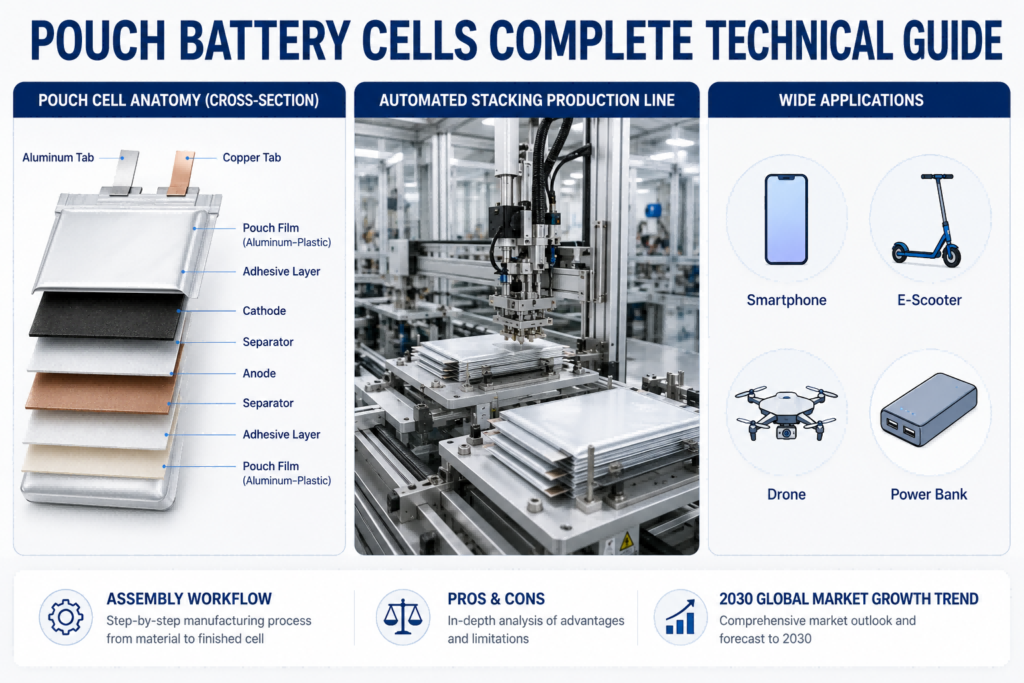
First launched commercially in 1995, pouch lithium-ion cells have become the fastest-expanding lithium battery format worldwide.
Unlike cylindrical and prismatic cells that use rigid steel or aluminum shells, pouch batteries rely on lightweight, heat-sealable flexible aluminum-plastic laminated film as their outer casing.
This soft-shell design delivers two game-changing benefits: ultra-low weight and fully customizable geometry. Pouch cells hit 90%–95% packaging efficiency — the highest space utilization rate among all mainstream lithium cell variants.
Nearly double the growth of cylindrical formats makes pouch cells essential knowledge for OEM designers, battery pack assemblers, procurement managers and electronics engineers across North America, Europe and Australia.
Pouch batteries follow the same lithium-ion electrochemical working principle as hard-shell cells. Their unique aluminum-laminate outer pouch is the defining differentiator. Every complete pouch cell relies on five non-negotiable core components:
Common materials: LFP, NMC, lithium cobalt oxide (LCO).
The cathode stores lithium ions during charging and releases ions during discharge, directly determining cell voltage and rated capacity.
Predominantly graphite carbon materials.
The anode absorbs lithium ions while charging and releases them during use. Stable anode composition directly impacts overall cycle lifespan.
Thin porous polyethylene or polypropylene membrane sandwiched between cathode and anode.
It blocks direct electrode contact to prevent internal shorts while letting lithium ions flow freely.
Lithium salt organic solution that acts as the ion transfer medium.
Even electrolyte saturation across electrode layers prevents hotspots and inconsistent cell performance.
This three-layer flexible film is exclusive to pouch cells:
Pouch cells feature fragile soft casings and thin electrode tabs, requiring high-precision automated production and strict multi-stage quality checks.
Standard industry assembly sequence:
Electrode Production → Slitting & Precision Stacking → Cell Encapsulation → Electrolyte Injection → Tab Welding → Heat Sealing → Degassing & Chemical Formation → Compression Calibration → TIM Dispensing → End-of-Line Full Performance Testing
| Comparison Item | Cylindrical Cell | Prismatic Cell | Pouch Cell |
|---|---|---|---|
| Outer Housing | Rigid steel/aluminum can | Rigid aluminum shell | Flexible aluminum-laminate film |
| Internal Layout | Wound jelly roll | Layer stacked electrodes | Precision flat stacking |
| Space Utilization | 60%–75% | 80%–85% | 90%–95% |
| Relative Weight | Heaviest | Medium | Lightest (20–40% lighter than hard-shell cells) |
| Shape Customization | Fixed round form | Fixed rectangular form | Fully custom size, thickness & curved geometry |
| Failure Mode Under Pressure | High risk of violent rupture/explosion | Severe casing deformation | Visible swelling only, no explosion hazard |
| Base Manufacturing Cost | Lowest | Mid-range | Highest |
| Typical Cycle Life | 800–1400 cycles | ~2,000 cycles | ~500 cycles |
All three formats rely on lithium ion movement between anode and cathode. Packaging structure and internal stacking design create all major performance and safety differences.
While pouch cells deliver unique design benefits, four core drawbacks limit universal deployment across all battery-powered equipment:
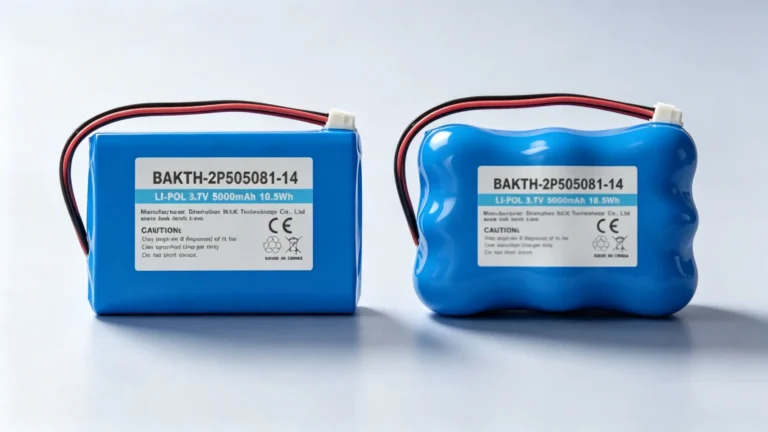
Electrolyte breakdown generates trapped gas inside the soft film casing during repeated charge-discharge cycles. Uncontrolled swelling warps device housings, squeezes internal hardware and gradually degrades cell capacity.
Thin aluminum-laminate film offers minimal protection against impact, punctures and heavy compression. Battery pack designers must add reinforcing frames and foam cushioning, raising total assembly material costs.
Custom unique sizes and multi-layer flexible packaging make automated sorting impossible. Manual separation of nylon, aluminum and polypropylene layers increases recycling labor expenses and lowers overall metal recovery efficiency. Uniform cylindrical cells are far easier to process at recycling facilities.
Basic pouch cells only deliver roughly 500 full charge cycles. Prismatic cells reach ~2,000 cycles, while cylindrical cells land between 800–1400 cycles. Faster capacity fade means more frequent battery replacements for long-cycle equipment.
Pouch cells react negatively to minor fluctuations in sealing temperature, compression force and tab welding power. Tiny process errors cause air leakage, electrolyte loss and premature cell failure over short usage periods.
Pouch cells excel in use cases that prioritize slim profiles, light weight and low continuous vibration. They are not recommended for heavy construction machinery, large commercial trucks or high-shock industrial gear without heavy reinforced housings.
Smartphones, tablets, TWS wireless earbuds, smart watches and fitness trackers. Flagship iOS and Android devices almost exclusively use pouch cells to balance thin chassis design and long daily runtime.
Compact power banks, small UPS units and lightweight portable medical power supplies. High energy density fits more storage capacity into travel-friendly compact sizes.
Electric scooters, lightweight e-bikes and auxiliary batteries for small passenger EVs. Custom shapes fit irregular frame cavities, and reduced vehicle weight extends maximum driving range.
Consumer and commercial drones, handheld test measurement tools, lightweight military field power modules.
A: Pouch cells feature a non-explosive failure mode — pressure buildup only creates visible swelling. However, their soft outer film is far more vulnerable to punctures and physical damage. Cylindrical metal cans offer superior mechanical shock resistance but risk violent rupture under extreme internal pressure.
A: The flexible aluminum laminate casing cannot contain gas produced by normal electrolyte side reactions during cycling. Optimized stack compression and full degassing during manufacturing can drastically reduce swelling severity over the cell’s service life.
A: Pouch cells work well for lightweight passenger EVs with mild road vibration. Heavy commercial trucks and off-road machinery still favor vibration-resistant cylindrical cells. Most major automotive OEMs now use mixed cell format packs to balance cost, weight and durability.
A: Three high-sensitivity production stages create the most defects: precision tab welding, consistent uniform compression and airtight heat sealing. All three demand high-precision automated assembly equipment to maintain batch quality standards.
A: Standard pouch cells average ~500 cycles, cylindrical cells range from 800–1400 cycles, and prismatic lithium cells deliver the longest lifespan at approximately 2,000 full charge-discharge cycles.
Pouch battery cells hold a unique competitive edge in the lithium industry thanks to unmatched space utilization, lightweight construction and fully customizable form factors. They remain the dominant cell choice for slim consumer electronics, portable backup power and lightweight e-scooter applications.
At the same time, inherent limitations including swelling tendencies, fragile outer packaging, shorter cycle life and complex recycling workflows restrict broad adoption in heavy-duty, high-vibration equipment.
Ongoing advances in automated stacking manufacturing, sealing process optimization and localized aluminum-plastic film production will narrow pouch cells’ performance-cost gap over the next several years. As design-for-recycling industry standards mature, pouch lithium technology will capture an even larger share of the global battery market through 2030.