Let's Shape The Future Of Your Investments!
Natoque iaculis cursus augue urna commodo aptent morbi tortor porttitor quis ornare.
![Lithium-ion Battery Manufacturer | BAKTH Battery [Official]](https://bakth-battery.com/wp-content/uploads/2026/05/hideLogo.png)
![Lithium-ion Battery Manufacturer | BAKTH Battery [Official]](https://bakth-battery.com/wp-content/uploads/2026/05/logo.png)
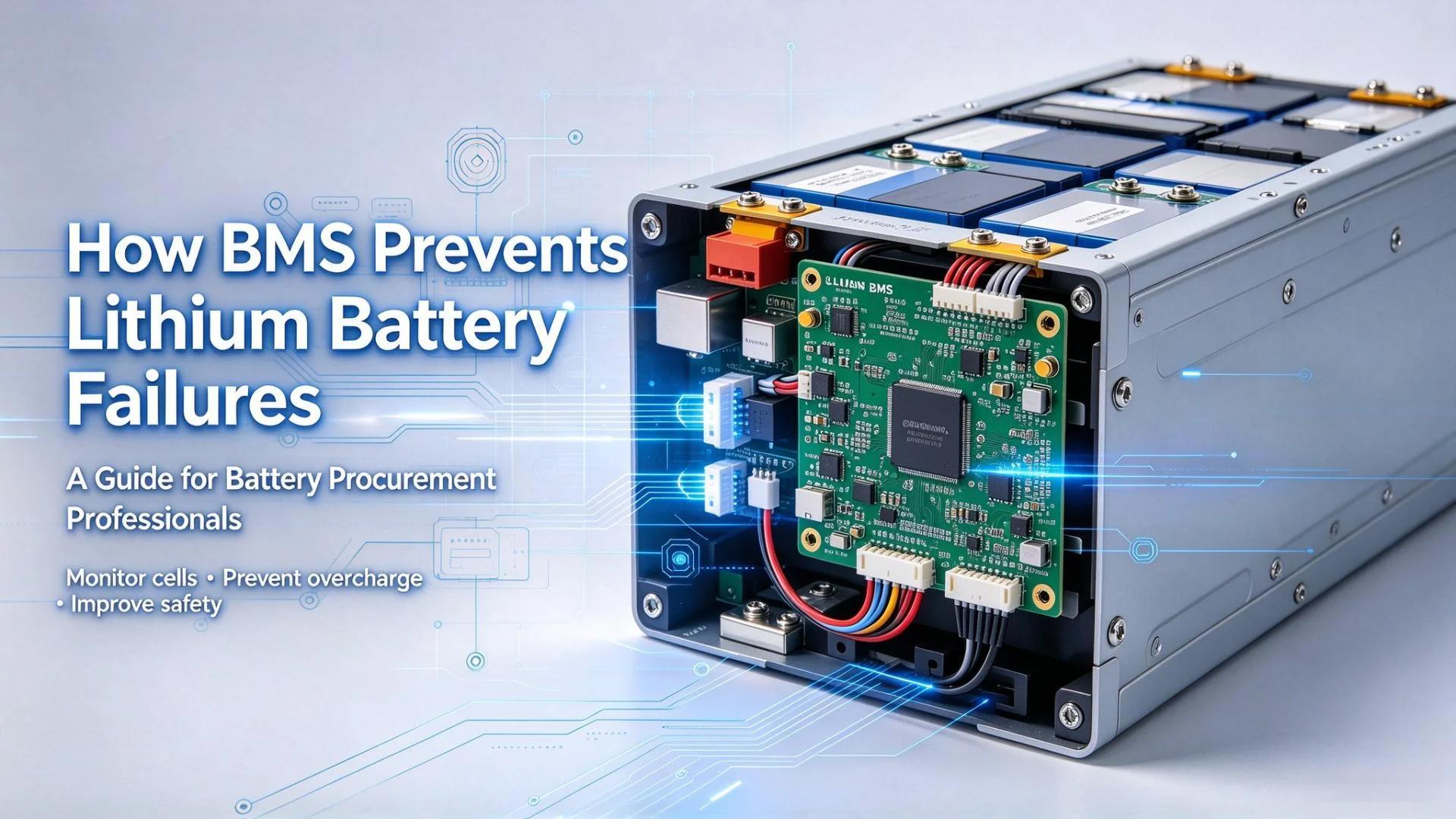
Lithium battery packs provide high energy density and reliable power for applications such as marine systems, RVs, solar energy storage, AGVs, robotics, and industrial equipment.
However, lithium batteries are sensitive to operating conditions such as voltage, temperature, current, and charging methods. Without proper protection and monitoring, abnormal conditions can accelerate battery degradation, reduce service life, and create safety risks.
A Battery Management System (BMS) acts as the control and protection center of a lithium battery pack. It monitors battery conditions, manages charging and discharging, and helps prevent common battery failures.
For battery procurement teams, understanding BMS functions is essential when evaluating suppliers and selecting reliable lithium battery solutions.
This guide explains how BMS technology prevents lithium battery failures and what buyers should check before purchasing battery packs.
A Battery Management System (BMS) is an electronic control system integrated into lithium battery packs.
Its main purpose is to monitor, protect, and optimize battery operation by collecting real-time data from the battery cells and controlling charging and discharging behavior.
A typical BMS monitors:
When the battery operates outside safe limits, the BMS can trigger protective actions, such as stopping charging, disconnecting output power, or limiting current.
Unlike lead-acid batteries, lithium battery chemistries require accurate monitoring and protection because overcharge, deep discharge, excessive current, and temperature abuse can permanently damage cells.
| BMS Function | How It Protects the Battery | Common Problems Prevented |
|---|---|---|
| Overcharge protection | Stops charging when cell voltage reaches the safe limit | Capacity loss, overheating, cell damage |
| Over-discharge protection | Disconnects the load before voltage becomes unsafe | Deep discharge, permanent capacity loss |
| Temperature protection | Monitors charging and operating temperature | Thermal stress, accelerated aging |
| Cell balancing | Keeps individual cells at similar voltage levels | Capacity reduction, weak cell failure |
| Overcurrent protection | Limits excessive current flow | Overheating, wiring damage, short-circuit risks |
| SOC/SOH monitoring | Tracks remaining capacity and battery condition | Unexpected shutdowns, poor maintenance planning |
| Communication functions | Sends battery data to external systems | Lack of visibility in industrial applications |
Overcharging forces lithium cells beyond their designed voltage range. This can accelerate electrolyte breakdown, increase internal pressure, and cause permanent cell degradation.
Deep discharge creates another major risk. When a lithium cell voltage drops too low, internal chemical changes may occur, reducing capacity and increasing the possibility of cell damage.
The BMS prevents these conditions by monitoring individual cell voltages and disconnecting charging or discharging when preset limits are reached.
This protection is one of the most important functions of a lithium battery management system.
Temperature has a significant impact on lithium battery performance and lifespan.
Low temperatures create additional challenges, especially during charging. Charging lithium batteries in very cold conditions may cause lithium plating, which can damage the cell structure.
High temperatures accelerate chemical reactions inside the cells, increasing aging speed and reducing cycle life.
A quality BMS monitors battery temperature and can:
For applications such as outdoor equipment, RVs, marine systems, and energy storage, temperature protection is an important BMS feature.
A lithium battery pack contains multiple cells connected in series and/or parallel.
Over time, small differences between cells can increase due to:
When cells become unbalanced, weaker cells reach voltage limits earlier than stronger cells. This reduces the usable capacity of the entire battery pack.
Cell balancing helps maintain consistent cell voltage.
Passive balancing removes excess energy from higher-voltage cells as heat.
Active balancing transfers energy between cells.
For industrial and energy storage applications, active balancing may provide better long-term performance.
Lithium batteries can deliver high current output, but excessive current can damage cells, wiring, connectors, and electronic components.
The BMS continuously monitors current flow and can disconnect the circuit when abnormal conditions occur.
This protection is especially important for:
A properly configured BMS helps prevent damage caused by sudden current spikes or short circuits.
Advanced BMS systems provide information about battery condition through:
SOC indicates the remaining available battery capacity.
Accurate SOC estimation helps users:
SOH indicates the overall condition of the battery compared with its original performance.
SOH monitoring helps maintenance teams identify aging batteries before they cause unexpected failures.
For commercial and industrial battery systems, these functions improve operational planning and reduce downtime.
Modern lithium battery packs often require communication between the BMS and external devices.
Common communication protocols include:
Communication functions allow battery data to be integrated with:
For large-scale battery projects, remote monitoring can help identify abnormal conditions before they become serious problems.
Many buyers focus primarily on:
However, the BMS is equally important.
Even high-quality lithium cells can experience performance problems if the BMS is poorly designed or incorrectly configured.
Common problems caused by low-quality BMS include:
When sourcing lithium battery packs, buyers should evaluate both the cells and the BMS as a complete system.
| Evaluation Item | Questions Buyers Should Ask Suppliers |
|---|---|
| Battery chemistry compatibility | Is the BMS designed for LiFePO4, NMC, Li-ion, or other chemistry? |
| Voltage configuration | Does the BMS match the series cell count and battery voltage? |
| Current rating | Can it support continuous and peak operating current? |
| Cell balancing | Is balancing passive or active? What is the balancing current? |
| Temperature protection | Does it support charging and discharge temperature protection? |
| Communication | Are CAN, RS485, Bluetooth, or other interfaces available? |
| Protection testing | Are BMS response tests available for overcurrent and temperature events? |
| Firmware settings | Can protection parameters be customized for the application? |
| Warranty | Are BMS-related failures covered under warranty? |
Fact: BMS quality varies significantly between manufacturers.
Some low-cost battery packs use basic protection boards with limited monitoring and balancing functions, while industrial battery packs often require advanced BMS systems.
Fact: Premium cells still require proper protection.
Lithium cells cannot regulate their own voltage, temperature, or current. A correctly designed BMS is necessary to operate cells safely and efficiently.
Fact: A BMS provides continuous monitoring and management.
Besides emergency protection, it helps maintain cell balance, optimize charging behavior, and provide battery health information.
When selecting a lithium battery supplier, consider:
A battery pack manufacturer should be able to explain how the BMS is matched with the cells, charger, and application requirements.
A reliable BMS is one of the most important components of a lithium battery pack.
It protects cells from abnormal operating conditions, improves battery reliability, supports maintenance management, and helps extend battery service life.
For battery procurement teams, evaluating BMS specifications should be just as important as checking cell quality and battery capacity.
Choosing a battery supplier with proper BMS design, accurate protection settings, and complete testing procedures can significantly reduce failure risks and improve long-term product performance.
A: Most lithium battery packs require appropriate protection and monitoring because lithium cells are sensitive to overcharge, deep discharge, excessive current, and temperature conditions. The specific protection requirements depend on the battery chemistry, application, and system design.
A: Passive balancing removes excess energy from higher-voltage cells as heat. Active balancing transfers energy between cells, making it more efficient for larger battery systems and long-cycle applications.
A: A poor-quality BMS may cause: Cell imbalance, incorrect protection, unexpected shutdowns, charging problems, inaccurate battery monitoring, reduced battery lifespan.
A: Integrated BMS designs are commonly used in standard battery packs because they simplify installation. External BMS solutions are often selected for larger custom battery systems where more flexibility, monitoring, and control are required.
A: Buyers should request: BMS model information, protection parameters, current ratings, communication specifications, balancing method, test reports, application examples. A professional supplier should be able to provide clear technical documentation before mass production.