Let's Shape The Future Of Your Investments!
Natoque iaculis cursus augue urna commodo aptent morbi tortor porttitor quis ornare.
![Lithium-ion Battery Manufacturer | BAKTH Battery [Official]](https://bakth-battery.com/wp-content/uploads/2026/05/hideLogo.png)
![Lithium-ion Battery Manufacturer | BAKTH Battery [Official]](https://bakth-battery.com/wp-content/uploads/2026/05/logo.png)
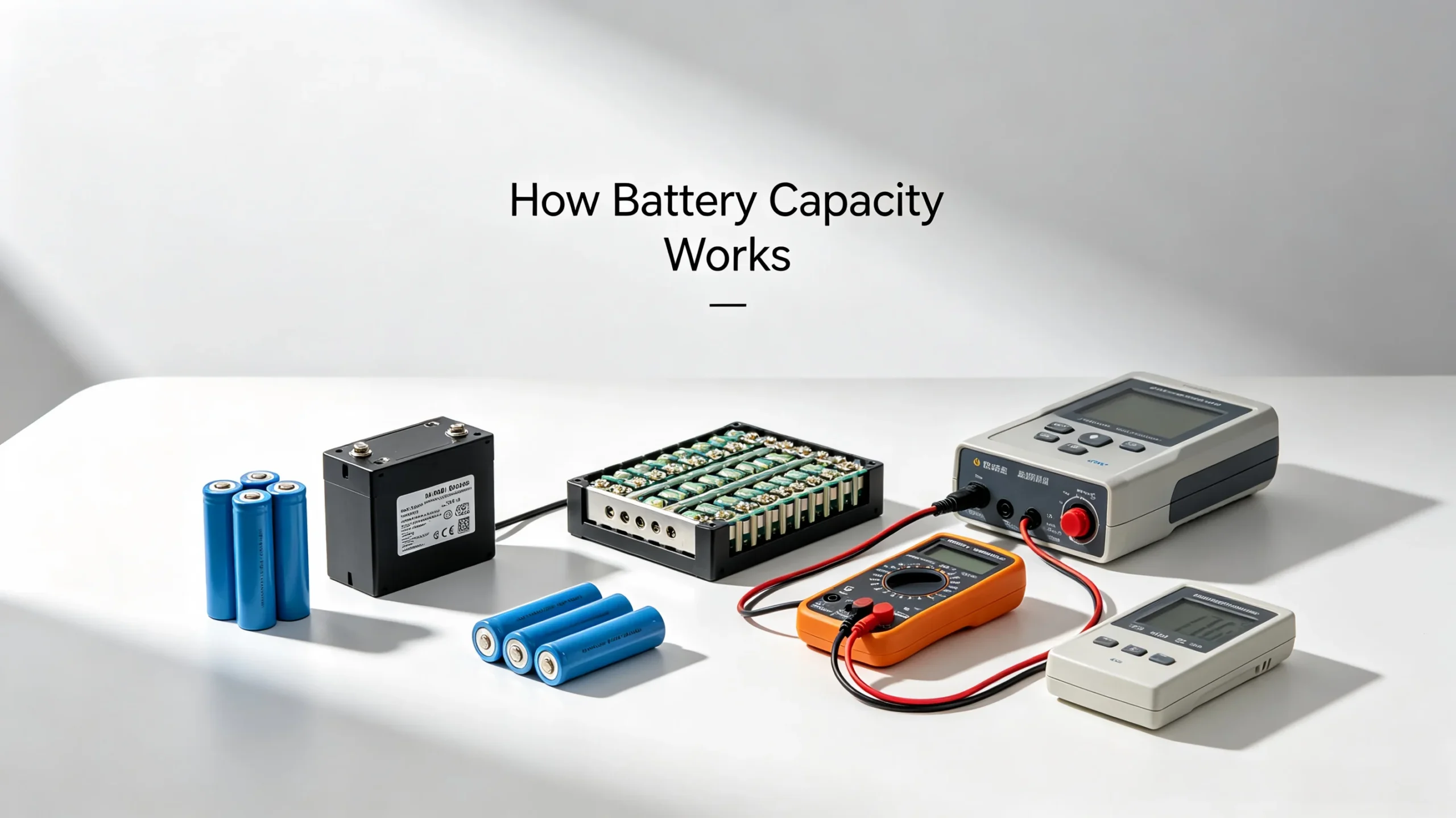
Battery capacity is the core parameter that defines how much electrical energy a rechargeable battery can store and deliver. It is the most intuitive metric for judging a battery’s endurance and overall performance.
Standard battery capacity units include milliampere-hour (mAh) for small devices (smartphones, wireless earbuds, power tools) and ampere-hour (Ah) for large batteries (12V leisure batteries, EV packs, solar storage batteries).
In short: The higher the battery capacity, the longer your device can run on a single full charge. A phone with a 5000mAh battery lasts far longer during browsing, gaming, or video playback than a 3000mAh model. Beyond daily convenience, adequate battery capacity reduces frequent charging cycles, cuts unnecessary energy consumption, and slows long-term battery aging.
Understanding battery capacity is essential when replacing device batteries, purchasing power banks, or designing solar/backup power systems. A capacity mismatch will lead to shortened runtime, low efficiency, and even permanent device or battery damage.
Battery capacity is not a fixed theoretical value — it is tested and verified through standardized industrial processes under controlled conditions. Manufacturers and third-party labs follow strict steps to measure true battery capacity:
This is why a battery’s rated capacity (label value) often differs slightly from its real-world capacity, which is affected by environment and usage habits.
Many users wonder why a new high-capacity battery fades quickly or fails to deliver promised runtime. These four core factors directly determine actual battery capacity and endurance:
Different battery materials have completely different energy storage limits and discharge efficiency. Common battery types and their capacity characteristics:
Battery chemistry fundamentally determines the upper limit of capacity, discharge stability, and service life.
All rechargeable batteries age naturally over time. With repeated charge-discharge cycles, internal electrode materials and electrolytes gradually degrade, causing irreversible capacity loss.
New batteries deliver full rated capacity, while aged batteries can only retain 70–80% of their original capacity after hundreds of cycles. This is why old phones, laptops, and power banks drain much faster even with full charges.
Temperature is one of the biggest invisible killers of battery capacity:
High humidity and extreme altitude can also interfere with battery discharge stability and reduce actual usable capacity.
Improper habits like frequent full discharge, overcharging, and long-term fast charging will accelerate capacity fading and reduce real battery performance.
Battery capacity is the foundation of all portable power and energy storage systems, with wide-ranging applications across daily life, commercial industries, and new energy fields:
High-capacity batteries support all-day use for smartphones, laptops, Bluetooth speakers, and cordless power tools, eliminating frequent charging interruptions and improving user experience.
EV driving range is directly determined by battery capacity. Larger-capacity battery packs provide longer single-charge mileage and stable power output, while matched charging efficiency ensures battery long-term health.
Off-grid solar and wind energy systems rely on high-capacity battery banks to store excess power generated during peak sunlight or wind. Sufficient capacity ensures continuous power supply at night or on low-generation days, stabilizing household and commercial off-grid power systems.
High-capacity backup batteries provide uninterrupted power for homes, hospitals, office buildings, and medical equipment during blackouts, preventing data loss and critical system shutdowns.
Massive high-capacity battery banks store surplus grid electricity during low-demand periods and release power during peak hours. This balances grid load, stabilizes power supply, and supports large-scale renewable energy integration.
Solid-state batteries, graphene composite electrodes and high-stability electrolyte formulas are emerging technologies that deliver higher energy density and slower capacity fading. When upgrading devices or replacement cells, choose new-generation high-stability batteries for longer-lasting capacity.
A: No. The maximum capacity of an integrated battery is limited by the device’s internal physical space and hardware design. External power banks are the only safe solution to extend runtime without modifying internal hardware.
A: Not always. Higher-capacity cells feature larger size and heavier weight, which may ruin portability for compact devices. Some low-quality high-capacity batteries use inferior raw materials and suffer faster capacity decay compared to smaller premium cells.
A: Lower remaining capacity shortens single-charge runtime significantly. A degraded battery with heavy capacity loss also struggles to sustain high power output, leading to sudden shutdowns under heavy loads like gaming or high-speed motor operation.
A: Keep charge levels between 20%–80% for daily use, avoid extreme hot/cold storage, use official matched chargers, and minimize daily fast charging frequency.
A: Aging cells with uneven capacity loss or uncalibrated BMS sensors cause skewed percentage displays. A complete full charge + full discharge calibration cycle can recalibrate the battery meter for more accurate readings.
A: Yes. Constantly active background apps, GPS, Wi-Fi and Bluetooth create continuous small loads that speed up daily discharge and accelerate cumulative capacity fading over hundreds of cycles.
Battery capacity is the core energy storage metric measured in mAh and Ah, governing how long any battery-powered device can run between recharges. Its real-world performance is shaped by four key factors: battery chemistry, natural aging, ambient temperature, and daily charging habits.
From consumer electronics and electric vehicles to solar storage and grid backup power, adequate battery capacity is the foundation of reliable portable and off-grid power systems. While you cannot permanently stop capacity fading, consistent proper charging, cool dry storage, regular maintenance and device software tuning can greatly slow capacity loss and extend your battery’s usable service life.