



Choosing between industrial batteries and consumer batteries involves more than comparing prices. The wrong battery can lead to equipment downtime, safety risks and premature failure. This guide explains their key differences, typical applications and essential selection criteria to help buyers and design engineers choose the right power source.
1. What Is an Industrial Battery?
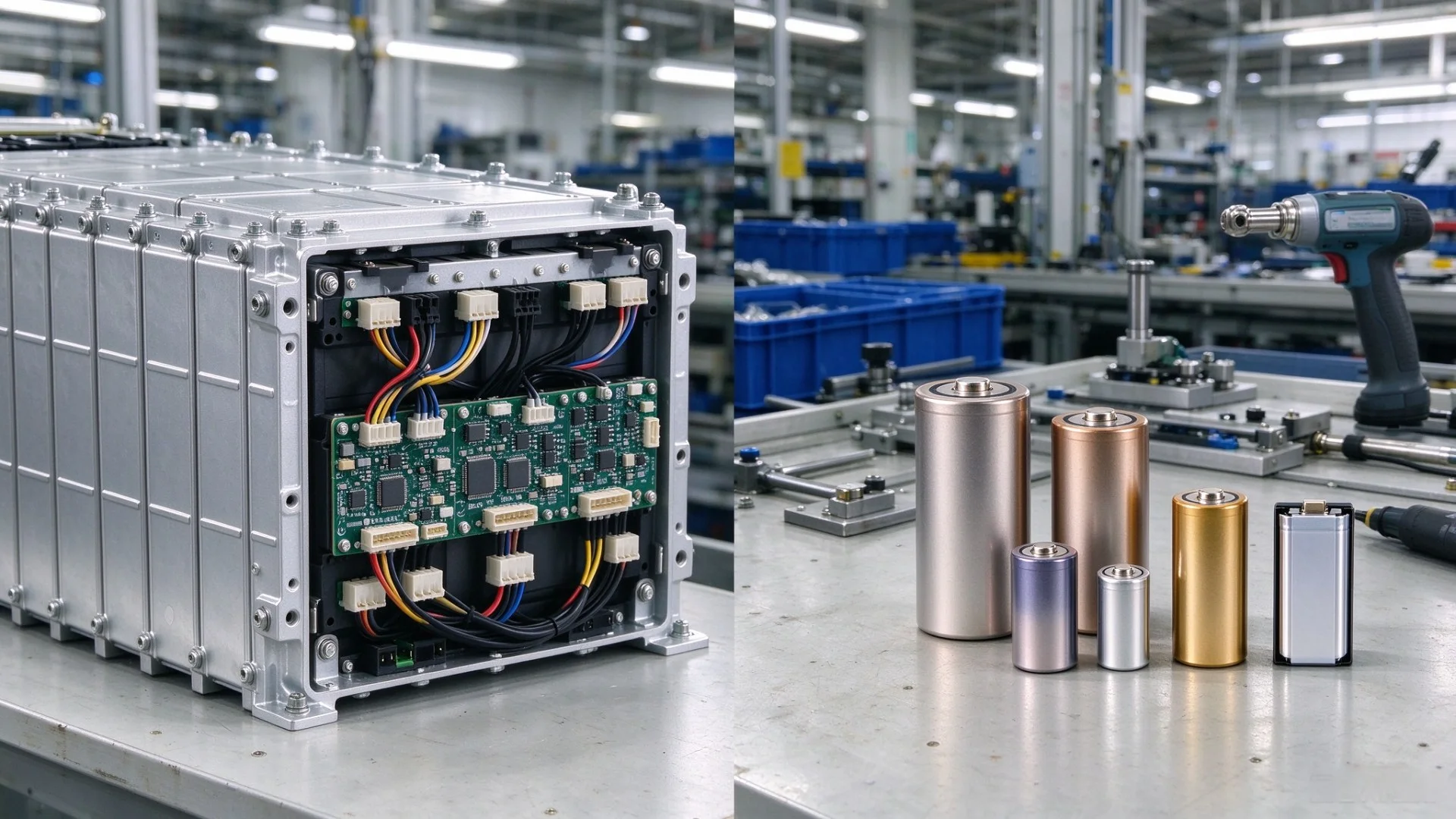
Industrial batteries are designed for demanding, heavy-duty applications where reliability and consistent performance are essential. They are engineered to withstand frequent cycling, vibration, mechanical shock and varying operating temperatures that standard consumer batteries may not be designed to handle.
Every aspect of their design — from cell materials and internal construction to the BMS and thermal management system — focuses on meeting specific equipment requirements and ensuring reliable operation over time.
Common industrial battery chemistries include LiFePO4, lead-acid, NiCd and specialised NiMH variants. Many industrial battery packs are custom-designed to match equipment requirements, including voltage, capacity, discharge current, dimensions and connection interfaces. Depending on the chemistry and design, industrial lithium battery packs can achieve several thousand charge-discharge cycles under specified operating conditions.
Typical industrial applications include:
- Forklifts, AGVs and warehouse material-handling equipment
- Solar and wind energy storage systems
- Construction, mining and heavy manufacturing machinery
- Marine vessels, rail equipment and specialised logistics vehicles
- Backup power systems for hospitals, data centres and critical infrastructure
One of the main advantages of industrial batteries is their potential to reduce total cost of ownership (TCO). Although the initial investment is often higher, longer service life, fewer replacements and reduced equipment downtime can lower operating costs over time.
2. What Is a Consumer (Regular) Battery?
Consumer batteries are mass-produced for everyday electronic devices and household applications. Their design focuses on affordability, standardised sizes and convenient retail availability. They are generally intended for low-to-moderate power requirements and applications with relatively predictable operating conditions.
Common consumer battery formats include AA, AAA, 9V, coin cells and rechargeable lithium-ion cells. Consumer NiMH rechargeable batteries are also widely used in household electronics.
Disposable alkaline and zinc-carbon batteries are designed for single use, while rechargeable lithium-ion and NiMH batteries can be reused over multiple charge-discharge cycles. Their actual cycle life varies depending on battery chemistry, product quality, discharge conditions and charging practices.
Typical consumer applications include:
- Remote controls, wall clocks and smoke alarms
- Flashlights, cameras and portable gaming devices
- Fitness trackers, hearing aids and wristwatches
- Children’s toys and small household gadgets
Consumer batteries are suitable for everyday electronics with relatively modest power demands. However, standard consumer-grade products may not be suitable for sustained high-current discharge, heavy vibration or prolonged exposure to extreme temperatures.
3. Core Differences: Industrial vs. Consumer Batteries
Industrial and consumer batteries differ in their construction, performance, protection systems, service life and intended applications.
| Comparison Factor | Industrial Batteries | Consumer Batteries |
|---|---|---|
| Design Purpose | Heavy-duty equipment and continuous operation | Everyday electronic devices |
| Construction | Application-specific materials and mechanical design | Cost-optimised, standardised construction |
| Operating Environment | Designed for demanding conditions, depending on model | Generally intended for controlled environments |
| Cycle Life | Often designed for extended cycling; chemistry and operating conditions determine actual life | Varies widely by chemistry and product type |
| Safety Protection | May include an application-specific BMS, cell monitoring and thermal protection | Protection varies by battery type and device design |
| Customisation | Voltage, capacity, dimensions, connectors and BMS can often be customised | Mostly standardised sizes and specifications |
| Initial Cost | Generally higher | Generally lower |
| Typical Applications | Forklifts, energy storage, industrial machinery and backup power | Remote controls, cameras, toys and household electronics |
Build Quality and Environmental Tolerance
Industrial batteries are often designed with application-specific cell selection, mechanical reinforcement, electrical protection and enclosure structures. Depending on the intended application, they may be tested for vibration, shock, humidity and wider temperature variations.
Consumer batteries are generally optimised for cost, size and convenience. Their operating temperature ranges and mechanical durability depend on the specific product and are not necessarily suitable for demanding industrial environments.
Cycle Life and Longevity
Industrial batteries are often designed to support frequent charging and discharging over extended service periods. For example, LiFePO4 battery packs can achieve several thousand cycles under suitable conditions, although actual performance depends on depth of discharge, temperature, charge and discharge rates, and BMS settings.
Consumer rechargeable batteries also have different cycle-life ratings depending on their chemistry and design. Their service life depends on usage frequency, charging habits and operating conditions.
It is important to distinguish between cycle life and calendar life. A battery may degrade over time even when it is not frequently used.
Safety and Electronic Protection
Industrial lithium battery packs commonly integrate a BMS to monitor cell voltage, current and temperature. Depending on the design, the system may also provide cell balancing, overcharge protection, over-discharge protection, overcurrent protection and short-circuit protection.
Consumer batteries have different levels of protection depending on their chemistry and application. Some rechargeable battery packs include built-in protection circuits, while disposable cells generally rely on correct handling and the device’s electrical design.
The appropriate protection system should always match the battery chemistry, configuration and operating requirements.
Cost Profile
Consumer batteries are generally inexpensive to purchase and easy to replace, making them practical for everyday devices.
Industrial batteries usually require a higher initial investment because of their specialised design, protection systems, testing and application-specific requirements. However, a longer service life and reduced downtime can make them more cost-effective over the equipment’s operating lifetime.
For commercial buyers, total cost of ownership is often a more useful comparison than purchase price alone.
Customisation
Industrial battery packs can often be customised to match specific equipment requirements, including:
- Voltage and capacity
- Battery dimensions and enclosure design
- Cell configuration and discharge rate
- Connectors, terminals and wiring harnesses
- BMS functions and communication protocols
- Mechanical protection and thermal management
Consumer batteries generally follow standardised dimensions and specifications, with limited options for customisation.
4. Can You Swap an Industrial Battery Into a Consumer Device?
In most cases, a direct replacement is not recommended. Using an industrial battery in a consumer device without checking compatibility can create electrical and mechanical risks.
Industrial battery packs may have different nominal voltages, dimensions, connector layouts and discharge characteristics. Their BMS settings and communication protocols may also be incompatible with the device’s original power management system.
An incompatible battery can cause charging problems, unexpected shutdowns, overheating or damage to electronic components.
It may also be unnecessarily expensive and oversized for a low-power application.
Industrial battery packs should only be used in consumer or modified equipment when their voltage, charging requirements, current limits, connectors, protection settings and physical dimensions have been verified by a qualified engineer.
5. Are Industrial Batteries Always Better?
No. The best battery depends on the application.
Using an industrial battery in a TV remote or wall clock would be unnecessary because the device does not require heavy-duty performance. The additional cost and capacity may provide little practical benefit.
On the other hand, using a standard consumer battery in a forklift, industrial robot or energy storage system may result in insufficient current capability, reduced service life and potential safety problems.
The right approach is to match the battery to the equipment’s power requirements, operating environment, expected service life and acceptable downtime.
6. Practical Battery Selection Checklist
Before selecting a battery, consider the following factors:
- Continuous load: High or sustained current requirements may call for an industrial-grade battery.
- Operating frequency: Frequent charge-discharge cycles generally require a battery designed for repeated cycling.
- Environmental conditions: Outdoor operation, vibration, shock and temperature extremes require suitable environmental and mechanical protection.
- Application requirements: Voltage, capacity, peak current and runtime must match the equipment.
- Maintenance requirements: Consider whether the battery requires regular inspection, watering or BMS monitoring.
- Downtime costs: If battery failure can interrupt production or critical operations, reliability should be a priority.
- Total cost of ownership: Compare purchase price, replacement frequency, maintenance and operational losses.
7. Final Thoughts
Industrial and consumer batteries are designed for different applications. Consumer batteries offer convenience, standardised sizes and low upfront costs for everyday electronic devices. Industrial batteries provide application-specific performance, durability and protection for demanding commercial and industrial systems.
Before making a purchase, consider both the initial investment and long-term operating costs. For industrial fleets, automated equipment and critical power systems, total cost of ownership is often more important than the upfront price.
Selecting the right battery chemistry, capacity, discharge capability and protection system is essential for achieving reliable performance and a longer service life.
8. Frequently Asked Questions
A: Not necessarily. Consumer rechargeable batteries have different discharge ratings, and many are not designed for sustained high-current applications. Excessive discharge current can cause overheating, accelerated degradation and potential safety risks. Always check the manufacturer’s specifications.
A: LiFePO4 is widely used in modern industrial applications, including energy storage, material-handling equipment and electric utility vehicles, because of its thermal stability and potential for long cycle life. Lead-acid batteries remain common in cost-sensitive applications and some forklift and backup power systems.
A: Standard disposable alkaline batteries are not designed for recharging. Attempting to recharge them can cause leakage, overheating or rupture. Only batteries explicitly labelled as rechargeable should be charged using a compatible charger.
A: No. Maintenance requirements depend on battery chemistry and design. Flooded lead-acid batteries require regular inspection and electrolyte maintenance, while sealed lead-acid and lithium battery packs generally require less routine maintenance. Lithium systems may still need periodic inspection of the BMS, connections and overall battery condition.