Let's Shape The Future Of Your Investments!
Natoque iaculis cursus augue urna commodo aptent morbi tortor porttitor quis ornare.
![Lithium-ion Battery Manufacturer | BAKTH Battery [Official]](https://bakth-battery.com/wp-content/uploads/2026/05/hideLogo.png)
![Lithium-ion Battery Manufacturer | BAKTH Battery [Official]](https://bakth-battery.com/wp-content/uploads/2026/05/logo.png)
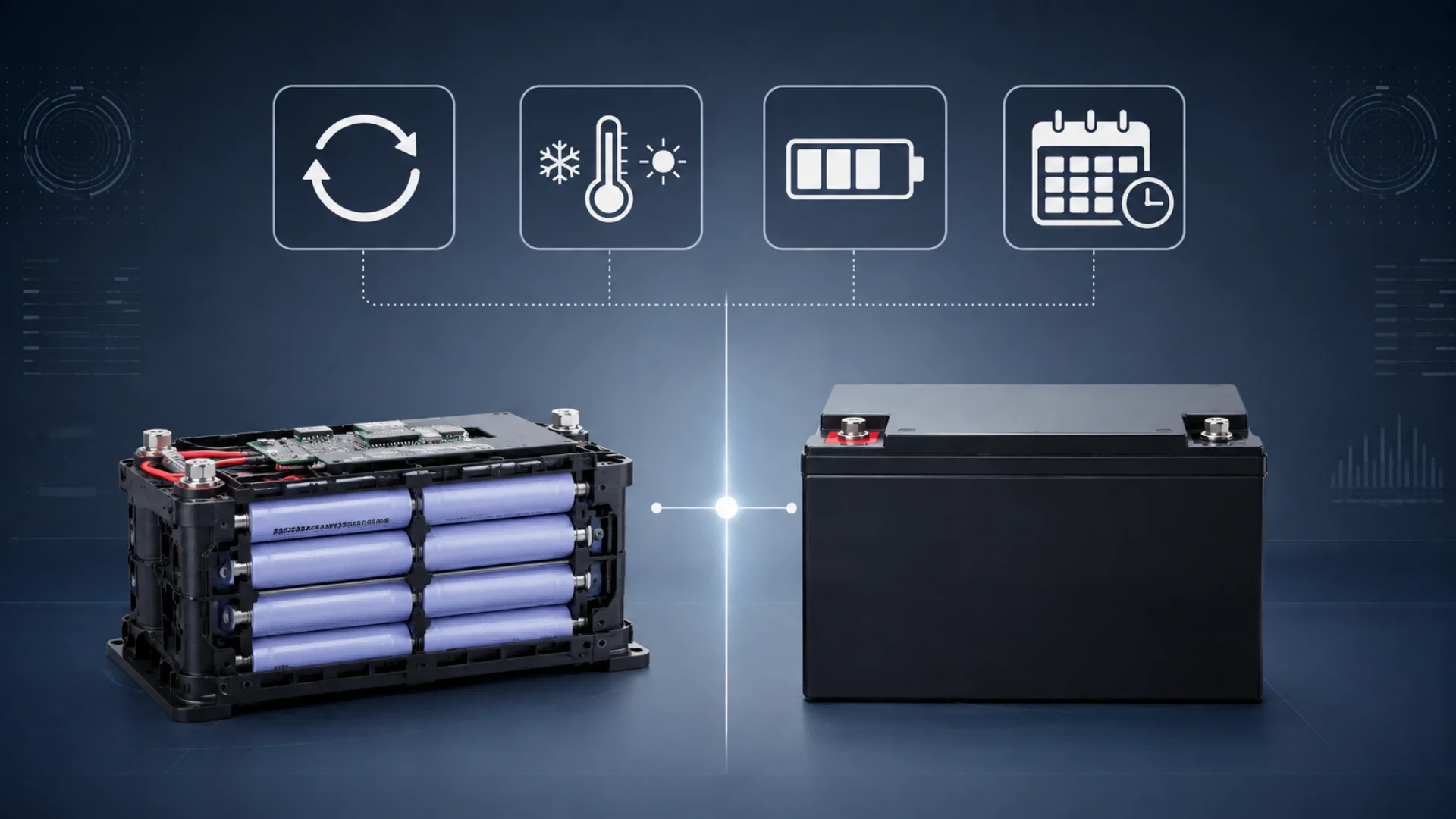
Battery cycle count is widely cited as a core metric for measuring battery lifespan, yet many vehicle owners and technicians misunderstand its real‑world value. Cycle count reliability varies drastically between lithium‑ion EV batteries and traditional 12V lead‑acid batteries. This guide clarifies what cycle count actually measures, its limitations across battery chemistries, and the true factors that dictate long‑term battery health and degradation.
A battery cycle refers to one full charge‑and‑discharge sequence, conventionally defined as draining a battery from 100% to 0% state of charge before recharging it back to full capacity.
In everyday real‑world use, most batteries never complete this full cycle. If you drain a lithium‑ion battery by 25% and recharge it completely four separate times, those four partial usages add up to one equivalent full cycle. This partial‑cycle math is how modern battery management systems track wear over time.
Cycle count records how many of these charge‑discharge sequences a cell has completed. However, this single number cannot tell you the full story of battery aging, and its predictive power changes completely depending on your battery chemistry.
Not all batteries age the same way. Cycle life benchmarks and degradation triggers differ significantly between lead‑acid variants and lithium‑ion packs.
Standard flooded lead‑acid car batteries typically deliver roughly 500 deep discharge cycles before capacity drops by around 30%. Their decline rarely comes purely from repeated cycling. Sulfation, long‑term calendar aging, vibration damage, and extreme heat are far more common root causes of early failure.
Enhanced Flooded Batteries and Absorbed Glass Mat batteries are engineered for higher cycling resistance. Most premium automotive AGM and EFB units can survive approximately 1200 deep cycles before suffering noticeable capacity loss. Even so, cycle tracking is rarely practical on standard 12‑volt vehicle systems, as factory hardware does not log cycle history data.
Lithium‑ion traction batteries are built with precise cycle‑life ratings. Well‑maintained EV lithium‑ion packs usually retain strong performance past 1200 full equivalent cycles. Most modern electric vehicle batteries carry manufacturer warranties covering 1000‑2000 cycles down to the 80% remaining‑capacity threshold.
Unlike 12‑volt car batteries, EV battery management systems continuously log partial‑cycle activity and calculate equivalent cycle values, making cycle‑count data one useful benchmark for lithium‑ion wear.
Even for lithium‑ion batteries, cycle numbers should never be treated as a standalone health report. Several hidden variables speed up degradation independently of total cycle volume.
How deeply you drain your battery shapes wear far more than how many times you cycle it. Lithium‑ion cells cycled gently between 20%‑80% state of charge will dramatically outlast batteries repeatedly run down to near‑zero or charged to 100% every single day.
Heat is one of lithium‑ion’s biggest enemies. Charging or discharging a battery under high‑temperature conditions accelerates internal chemical breakdown, eating away at usable life even with very few charge‑discharge cycles. Cold weather carries milder risks, though prolonged freezing conditions can also stress cells.
Batteries age over time, whether you use them or not. A five‑year‑old lithium pack with low cycle usage will still show gradual capacity fade from natural chemical aging. This calendar degradation applies equally to lead‑acid and lithium chemistries.
Vehicle technicians, fleet operators, and everyday drivers can follow these actionable habits to slow battery degradation, regardless of chemistry type.
A: A full cycle is completed once a battery discharges from 100% SOC down to 0% and recharges fully. Partial discharges are added together by the BMS to calculate equivalent cycle counts.
A: Most modern electric‑vehicle lithium‑ion packs are rated for 1000‑2000 full equivalent cycles before dropping to 80% original capacity. Under typical daily partial‑cycle usage, this translates to 8‑15 years of usable service.
A: Cycle count is not a reliable health metric for automotive 12V lead‑acid batteries. Conductance testing provides far more accurate, real‑time insight into remaining battery condition.
A: Daily full‑charge sessions create extra long‑term stress for lithium‑ion cells. For regular commuting, keeping your daily charge limit set to 80% will help preserve battery life; save 100% charging exclusively for long road trips.
A: State of Health (SoH) testing measures remaining usable capacity compared to the brand‑new factory specification. SoH results combined with cycle history, temperature logs and age data deliver the most complete picture of battery degradation.