Let's Shape The Future Of Your Investments!
Natoque iaculis cursus augue urna commodo aptent morbi tortor porttitor quis ornare.
![Lithium-ion Battery Manufacturer | BAKTH Battery [Official]](https://bakth-battery.com/wp-content/uploads/2026/05/hideLogo.png)
![Lithium-ion Battery Manufacturer | BAKTH Battery [Official]](https://bakth-battery.com/wp-content/uploads/2026/05/logo.png)
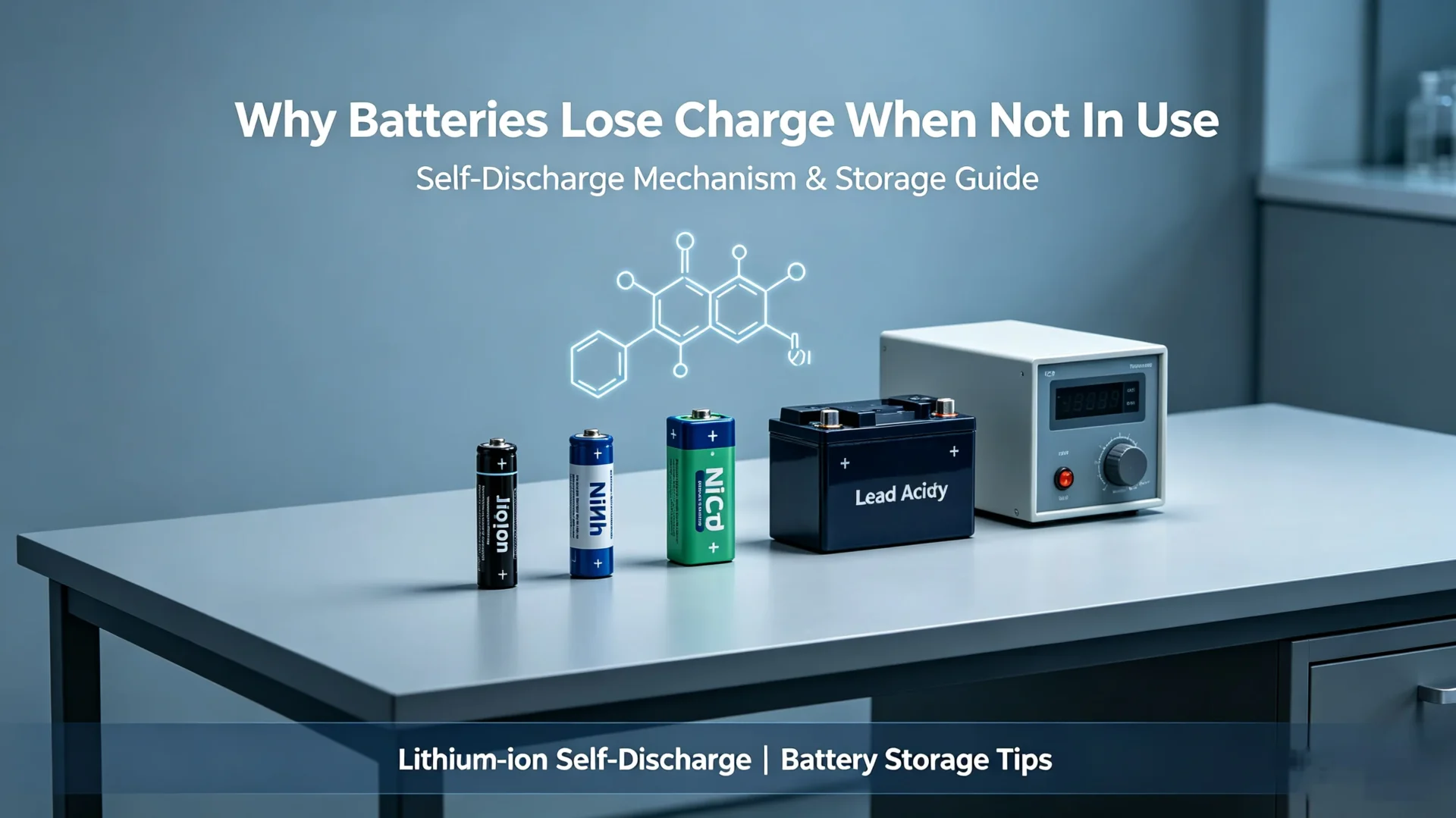
It’s a common frustration: fully charge a battery, store it away unused, and return later to find it partially or fully drained. This mysterious power loss is not a device fault—it is natural battery self-discharge.
This guide explains the core science behind idle battery drain, compares self-discharge rates across common battery types, and shares actionable tips to minimize unnecessary power loss.
Batteries store electrical energy through stable electrochemical balances between electrodes and electrolyte. No battery cell is chemically inert at rest. Even when completely disconnected from devices and external loads, continuous low-level internal reactions gradually consume stored energy.
Electrons and active ions inside the battery seek chemical equilibrium, triggering subtle spontaneous side reactions, tiny internal micro-leakage currents, and minor material decomposition. This passive energy depletion, defined as self-discharge, is a universal, unavoidable law for all battery chemistries. No battery can hold 100% charge indefinitely during long-term storage.
Different battery designs and materials create huge gaps in idle power loss speed. Below is an accurate monthly self-discharge benchmark for mainstream rechargeable batteries under standard room-temperature storage:
| Battery Type | Monthly Self-Discharge Rate | Performance Characteristics |
|---|---|---|
| Lithium-Ion | 2–3% | Lowest idle drain, ideal for long-term storage; mainstream for consumer electronics & EVs |
| Low-Discharge NiMH | 0.25–0.5% | Ultra-low self-discharge, perfect for standby small electronic devices |
| Standard NiMH | 25–30% | Fast idle drain; requires frequent top-ups during storage |
| Ni-Cad | 15–20% | Moderate self-discharge + obvious memory effect; outdated technology |
| Lead-Acid | 4–6% | Stable idle loss; widely used for automotive and stationary storage |
Lithium-ion batteries dominate modern electronics precisely because of their ultra-low self-discharge rate. Standard NiMH batteries lose nearly one-third of their charge monthly, making them unsuitable for long idle use without regular maintenance.
Temperature is the most influential external factor affecting self-discharge speed.
High ambient heat drastically accelerates internal chemical reactions and micro-leakage currents, doubling or even tripling idle power loss. Storing batteries in hot garages, closed car cabins or sun-exposed spaces rapidly drains charge and accelerates permanent aging.
Conversely, cool and dry environments effectively suppress spontaneous side reactions and slow self-discharge. Room temperature (15–25°C / 59–77°F) is the optimal condition for battery storage.
Note: Freezing temperatures are not recommended. Extreme cold causes condensation inside battery casings, damages internal circuits, and triggers hidden safety risks.
While self-discharge cannot be eliminated entirely, these simple, science-backed practices greatly reduce idle power loss and preserve battery health:
Avoid hot, humid, or enclosed spaces. Keep idle batteries indoors at stable room temperature, away from direct sunlight, heating equipment and high-humidity areas. Never leave electronic devices or power batteries inside parked cars in summer.
Do not place batteries in freezers or refrigerators. Temperature fluctuations produce condensation, which penetrates internal gaps, causes corrosion, and worsens long-term self-discharge.
All batteries age over time. Aging cells develop increased internal resistance and micro-defects, leading to abnormally fast self-discharge. If a fully charged battery drains completely within just days of storage, it is worn out and needs professional recycling and replacement.
Battery self-discharge is an inherent physical and chemical characteristic rather than a product defect. Every battery slowly loses charge while idle, with drain speed determined primarily by battery chemistry and storage temperature.
Lithium-ion and low-discharge NiMH batteries deliver superior shelf performance with minimal idle power loss, while standard nickel-based and lead-acid batteries require more frequent maintenance. By adhering to cool, dry storage habits, users can effectively slow self-discharge, preserve battery activity, and extend overall service life.
A: Yes. All batteries undergo natural self-discharge via low-level internal chemical reactions, even with no external load connected. This is completely normal and unavoidable.
A: Lithium-ion batteries feature the lowest monthly self-discharge rate (2–3%) among mainstream batteries, followed by low-discharge NiMH cells, making them ideal for long-term storage.
A: Absolutely. High temperatures accelerate internal chemical side reactions and micro-leakage, significantly speeding up idle battery drain and permanent aging.
A: No. Self-discharge follows natural physical laws. It can only be slowed via scientific storage methods but cannot be fully eliminated.
A: Aging batteries have increased internal resistance, tiny micro-shorts and degraded internal materials, leading to drastically faster self-discharge and poor charge retention.