Let's Shape The Future Of Your Investments!
Natoque iaculis cursus augue urna commodo aptent morbi tortor porttitor quis ornare.
![Lithium-ion Battery Manufacturer | BAKTH Battery [Official]](https://bakth-battery.com/wp-content/uploads/2026/05/hideLogo.png)
![Lithium-ion Battery Manufacturer | BAKTH Battery [Official]](https://bakth-battery.com/wp-content/uploads/2026/05/logo.png)
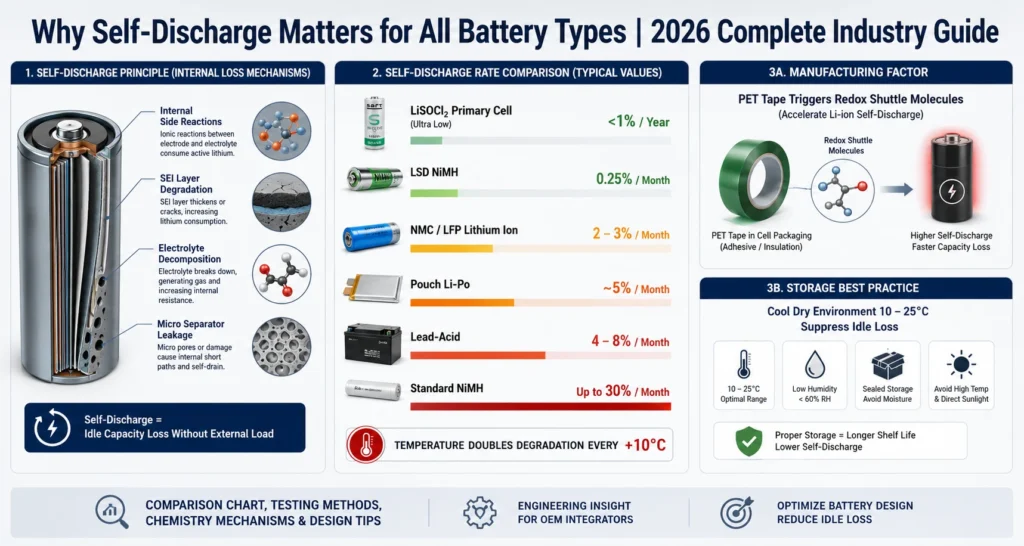
Every battery gradually loses stored energy while sitting idle, disconnected from any external load — this natural chemical loss is defined as self-discharge. Unlike parasitic drain from device standby circuits, self-discharge stems purely from internal side reactions inside sealed cells, and it cannot be fully eliminated, only controlled and minimized.
Self-discharge performance directly determines a battery’s shelf life, long-term storage reliability, and viable use cases. Cells with excessive self-discharge become unusable for remote sensors, backup UPS systems, medical equipment, and seasonal gear that sits unused for months or years. For product engineers, procurement teams and equipment operators across North America, Europe and Australia, understanding self-discharge mechanisms, measurement standards and chemistry tradeoffs is essential to avoid premature battery failure and costly field replacements.
This guide breaks down self-discharge rates across every mainstream battery type, explains accurate testing workflows, dives into chemistry-specific degradation pathways, and covers a groundbreaking research finding about how common PET assembly tape worsens lithium-ion self-discharge.
Self-discharge describes the steady decline of a battery’s state of charge (SoC) during open-circuit idle storage. Even with zero devices connected, spontaneous internal chemical reactions slowly consume active lithium, lead or nickel materials, permanently reducing usable capacity over time.
High self-discharge creates three critical business and user pain points
Primary (non-rechargeable) lithium and alkaline cells naturally feature far lower self-discharge than most secondary rechargeable batteries — though optimized low-self-discharge NiMH is a notable exception to this rule. Core variables controlling self-discharge speed include ambient temperature, storage state of charge, internal material purity, separator quality and cell assembly materials.
The table below summarizes standard idle capacity loss metrics for every widely deployed battery technology, split between disposable primary and rechargeable secondary cells:
| Battery Chemistry | Rechargeable? | Typical Self-Discharge / Shelf Life Benchmark |
|---|---|---|
| Lithium Metal Primary | No | 10-year full shelf life (ultra-low self-discharge) |
| Alkaline Primary | No | 5-year shelf life |
| Zinc-Carbon Primary | No | 2–3 years shelf life |
| Lithium-Ion (NMC/LFP) | Yes | 2–3% capacity loss per month |
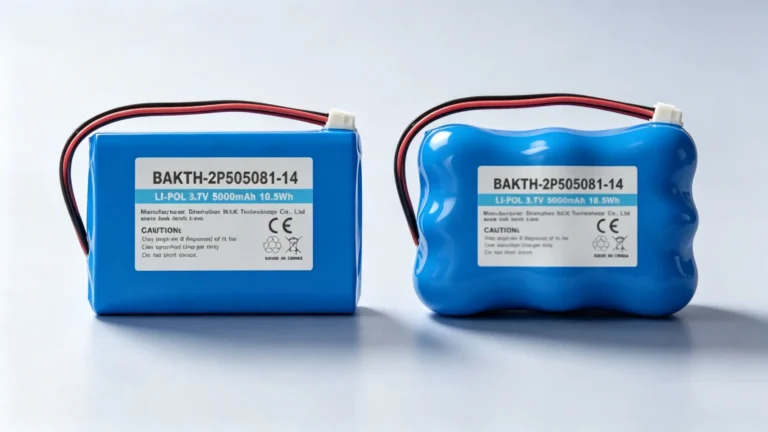
| Lithium-Polymer Pouch | Yes | ~5% capacity loss per month |
| Low Self-Discharge NiMH (LSD NiMH) | Yes | As low as 0.25% loss per month |
| Flooded / AGM Lead-Acid | Yes | 4–6% capacity loss per month; flooded up to 8% monthly |
| Nickel-Cadmium (NiCd) | Yes | 15–20% capacity loss per month |
| Standard High-Capacity NiMH | Yes | Up to 30% capacity loss per month |
Key observation: Temperature amplifies all self-discharge rates exponentially. Every 10°C rise above room temperature roughly doubles internal chemical reaction speed and idle capacity loss.
There is no universal testing method for self-discharge; protocols shift based on battery chemistry and required measurement precision. Two primary industry testing workflows dominate commercial labs: open-circuit voltage (Voc) tracking and coulomb counting.
Voc testing tracks voltage drop over weeks/months to calculate idle capacity loss, but it carries major limitations for lithium chemistries:
For all lithium-ion and lithium-polymer packs, coulomb counting is the industry gold standard. Testers log total charge input during full charging and total energy output during full discharge across multi-week storage intervals, calculating exact percentage capacity lost to internal self-reactions with high precision.
Lead-acid self-discharge speed varies drastically by construction and storage temperature:
Temperature is the dominant accelerating factor for lead-acid self-discharge. At 45°C storage, capacity loss over 6 months is three times faster than cells held at 25°C, creating major reliability risks for vehicle batteries, outdoor UPS and industrial backup power in hot climates.
NiMH internal insulator design creates a direct tradeoff between maximum capacity and idle retention:
Three core internal defects drive lithium-ion self-discharge:
Mitigation best practices for lithium cells: Store between 10°C–25°C in dry environments, implement BMS overcharge protection, and select cells with high-purity electrolyte and reinforced separators to slow self-discharge. Lithium-pouch soft packs average ~5% monthly self-discharge, higher than rigid cylindrical/prismatic lithium-ion’s 2–3% monthly loss.
Bobbin-format lithium thionyl chloride primary cells deliver the lowest self-discharge on the global market, enabled by a natural lithium chloride (LiCl) passivation layer that forms on the lithium anode surface. This thin inert film blocks continuous internal chemical reactions, pushing self-discharge rates below 1% per year and supporting up to 40 years of usable shelf life for low-power remote industrial sensors.
Key tradeoff of the passivation layer: When the cell sits unused for years, the LiCl film raises initial internal resistance, causing a temporary voltage drop on first discharge. The passivation layer gradually wears away under load, restoring stable output current.
Manufacturing material purity creates massive performance gaps for LiSOCl₂ cells:
Spiral-wound LiSOCl₂ variants sacrifice ultra-low self-discharge for higher peak discharge current capability.
Recent university battery research identified an overlooked manufacturing component that drastically increases lithium-ion self-discharge: standard PET (polyethylene terephthalate) electrode binding tape used during cell stacking assembly.
At elevated storage temperatures, PET tape slowly decomposes and releases redox shuttle molecules. These organic compounds continuously cycle between cathode and anode while the cell sits idle, creating permanent background leakage that drains stored capacity month over month.
Controlled oven testing visually confirmed the chemical breakdown effect:
Replacing PET tape with chemically inert alternative binding materials eliminates this shuttle compound formation and significantly cuts lithium-ion idle self-discharge rates for high-temperature storage applications.
A: Bobbin-style lithium thionyl chloride primary cells offer <1% annual self-discharge and up to 40-year shelf life, followed by low self-discharge NiMH at ~0.25% monthly capacity loss.
A: Yes. Every 10°C temperature increase roughly doubles internal chemical reaction speed, drastically speeding idle capacity loss for all rechargeable and primary batteries.
A: Pouch soft aluminum-laminate packaging offers weaker moisture and oxygen barrier protection, accelerating electrolyte side reactions and monthly self-discharge (~5% monthly vs 2–3% for rigid lithium cells).
A: Confirmed by academic research. PET decomposes at warm temperatures to create redox shuttle molecules that continuously drain cell charge during idle storage; switching to inert tape mitigates this issue.
A: Self-discharge is internal chemical capacity loss with zero external load connected. Parasitic drain is power consumed by device standby circuits, clock boards or monitoring hardware attached to the battery terminals.
A: Coulomb counting is the standard precise method. Tracking open-circuit voltage (Voc) is unreliable for lithium cells due to their flat discharge voltage curve.
A: A natural lithium chloride passivation film forms on the lithium anode, blocking continuous internal side reactions and suppressing annual self-discharge below 1% for decades of storage.