Let's Shape The Future Of Your Investments!
Natoque iaculis cursus augue urna commodo aptent morbi tortor porttitor quis ornare.
![Lithium-ion Battery Manufacturer | BAKTH Battery [Official]](https://bakth-battery.com/wp-content/uploads/2026/05/hideLogo.png)
![Lithium-ion Battery Manufacturer | BAKTH Battery [Official]](https://bakth-battery.com/wp-content/uploads/2026/05/logo.png)
Lithium-ion batteries power electric vehicles, drones, portable electronics, industrial energy storage and warehouse equipment worldwide, valued for their unmatched high energy density and lightweight design. However, one critical safety flaw limits their deployment without strict safeguards: thermal runaway.
Thermal runaway is an irreversible self-accelerating chemical chain reaction inside lithium cells. Once triggered, rising internal heat generates more exothermic reactions, pushing temperatures to hundreds of degrees Celsius in seconds, leading to toxic gas venting, swelling, fire or violent cell rupture. Unlike standard electrical fires, lithium battery thermal runaway generates its own oxygen source, making it extremely difficult to contain or extinguish.
This in-depth guide breaks down the full science of thermal runaway, its cascading failure stages, all operational and manufacturing root causes, life-threatening hazards, and split prevention playbooks for end users/facility operators and battery production manufacturers. It serves as essential safety training material for factory teams, warehouse managers, OEM integrators, fire safety officers and equipment hobbyists across North America, Europe and Australia.
Thermal runaway describes a destructive positive feedback loop inside lithium-ion cells: any initial heat source raises internal temperature, which speeds up electrolyte and electrode decomposition reactions that release even more heat. This cycle accelerates exponentially until catastrophic cell failure occurs.
Standard lithium-ion cells use flammable organic liquid electrolyte, making them far more susceptible to runaway than lead-acid or low-energy primary chemistries. A key challenge for safety teams: thermal runaway onset is unpredictable, and once initiated, the reaction cannot be stopped by removing the original trigger heat or power load. Even after disconnecting all external circuits, the cell will continue self-heating until all reactive internal materials are fully consumed.
Thermal runaway creates multi-layered risks for personnel, facilities and surrounding equipment, with three core dangerous outcomes:
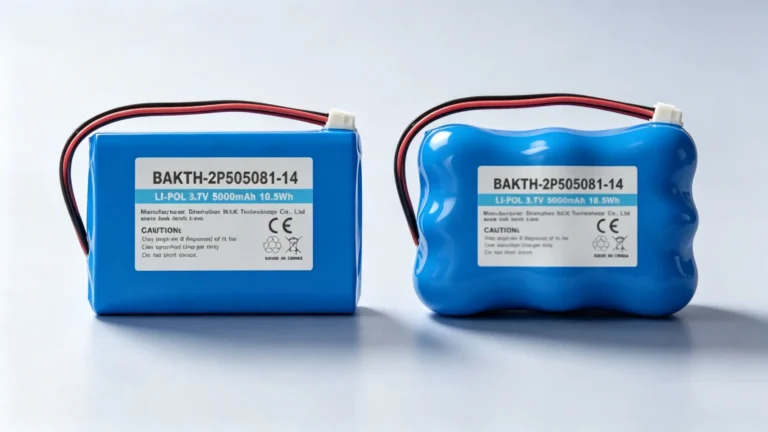
Rapid decomposition of cathode materials releases free oxygen, while electrolyte breakdown produces highly flammable hydrogen, methane and ethylene gases. Trapped gas inflates the cell pouch/casing until pressure ruptures the shell, jetting burning electrolyte and flame. In multi-cell packs, heat radiates to neighboring cells, causing cascading pack-wide thermal runaway propagation.
Thermal breakdown releases corrosive, toxic fumes including carbon monoxide and hydrofluoric acid (HF). These airborne pollutants harm on-site staff and contaminate factory floors, warehouse spaces and outdoor environments long after the fire is suppressed.
Vented electrolyte eats away at metal, plastic and electrical components. Severe swelling, rupture and fire destroy connected machinery, storage racks, facility wiring and building materials, leading to costly production downtime and structural repair expenses.
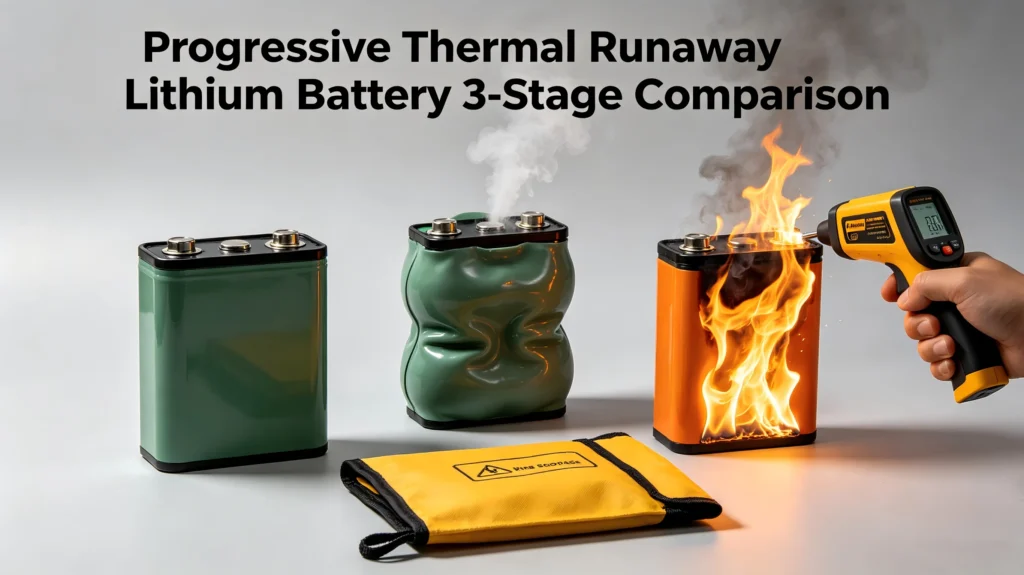
Every thermal runaway event follows a clear three-stage sequence, with a critical intervention window before irreversible catastrophic failure:
Mechanical, electrical or thermal stress damages internal cell structures, gradually raising internal temperature and pressure. Minor gas generation begins, but the reaction is still controllable if cooling and load isolation are applied immediately. This is the only window to fully prevent full thermal runaway.
Temperatures climb rapidly, and flammable gas vents from the cell casing. Visible swelling, faint chemical odors or minor warmth become detectable. At this stage, the risk of full runaway rises sharply, and the battery must be isolated to a fireproof outdoor zone immediately.
The point of no return. Internal temperatures surge hundreds of degrees within seconds, thick smoke emits, and the separator film between anode and cathode fully melts, creating a massive internal short circuit. Violent pressure buildup ruptures the cell, triggering flame ejection and full combustion of internal active materials. Cell-to-cell propagation begins in multi-module packs.
All thermal runaway incidents trace back to either improper user operation or hidden manufacturing defects. We break down both root cause groups in detail below.
These avoidable daily handling errors are the most common runaway triggers in commercial facilities and consumer equipment:
Even correctly operated batteries can suffer thermal runaway due to inconsistent production quality control. Seven critical factory flaws create permanent internal hazards:
For warehouse operators, factory staff, equipment owners and facility safety teams, these standardized daily practices eliminate nearly all abuse-induced thermal runaway risks:
Battery OEMs and cell production factories address thermal runaway risks at the design, material and assembly level through three core engineering strategies: prevent internal shorts, boost thermal stability, and block overcharge events. Specific production and design improvements include:
A: Yes. Internal manufacturing defects, internal short circuits from dendrite growth, or chronic overcharging can trigger thermal runaway even at room ambient temperature.
A: No. NMC/NCA high-energy lithium cells feature loose cathode oxygen bonds and ignite easily under abuse. LiFePO4 (LFP) cathodes have stable crystal structures, requiring far higher temperatures to initiate runaway, making them safer for stationary storage and low-speed mobility.
A: Definitely. Aged cells develop high internal resistance, lithium dendrite buildup and degraded SEI layers, drastically lowering the temperature threshold that initiates thermal runaway. Swollen aged packs must be removed from service immediately.
A: Fully initiated thermal runaway is self-sustaining and nearly impossible to halt. All safety protocols focus on early intervention during Stage 1 abuse/off-gassing to prevent the reaction from reaching the catastrophic Stage 3 failure point.
A: Mismatched anode-cathode capacity leading to lithium dendrite formation is the most prevalent latent factory defect, creating delayed internal short circuits that surface months after production.
A: Fireproof storage bags, lithium-specific Class D fire extinguishers, insulated handling tongs, gas detection sensors for CO/HF, and designated isolated outdoor hazard zones for overheating cell isolation.
Lithium-ion batteries deliver unmatched performance for modern industrial, mobility and consumer applications, but their flammable organic electrolyte creates an inherent thermal runaway hazard if improperly manufactured, stored or operated.
Thermal runaway unfolds in three predictable stages, with a narrow early intervention window to avoid catastrophic fire, toxic gas release and facility damage. Risks stem from two distinct sources: preventable user operational abuse and latent production manufacturing defects.
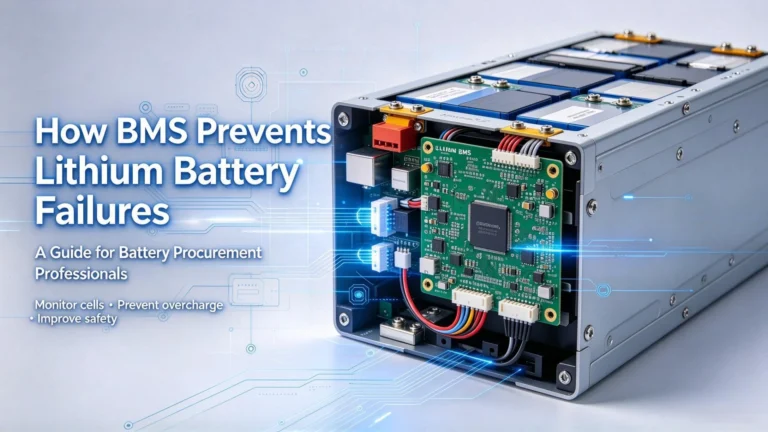
Facility managers and equipment users can drastically cut hazards by following temperature control, proper charging, storage and aging replacement rules. Battery manufacturers eliminate root failure triggers through stable material upgrades, strict assembly insulation standards, precision electrode balancing and intelligent BMS thermal monitoring.
By combining front-end manufacturing safety design with consistent end-user handling protocols, businesses can fully mitigate thermal runaway risks and maintain compliant, secure lithium battery operations across all global sites.