Let's Shape The Future Of Your Investments!
Natoque iaculis cursus augue urna commodo aptent morbi tortor porttitor quis ornare.
![Lithium-ion Battery Manufacturer | BAKTH Battery [Official]](https://bakth-battery.com/wp-content/uploads/2026/05/hideLogo.png)
![Lithium-ion Battery Manufacturer | BAKTH Battery [Official]](https://bakth-battery.com/wp-content/uploads/2026/05/logo.png)
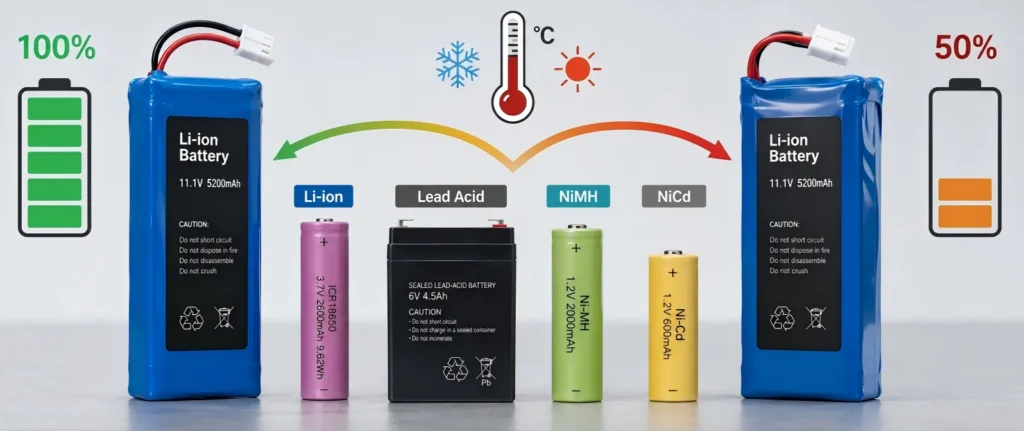
Fact: Fully charged lithium-ion batteries absolutely self-discharge when disconnected from any device — but the monthly power loss is far milder than older battery chemistries like NiCd and standard NiMH.
This slow idle power loss rarely creates issues for daily phone, laptop or e-scooter use. However, it becomes a major headache for seasonal gear, backup power stations and inventory batteries stored for months, especially during hot summer weather.
Many new battery users are surprised to find their fully charged lithium packs nearly dead after sitting untouched in a garage or car for several months. Unlike lead-acid or nickel-based cells, lithium’s self-discharge works differently, and understanding the mechanics lets you extend battery lifespan significantly. This guide breaks down every key detail, from chemical root causes to easy storage fixes.
Self-discharge describes the natural, spontaneous loss of stored energy in a battery while it sits in an open-circuit state — meaning zero electronics, wires or loads are connected to the terminals.
No matter how well you seal a lithium cell, tiny internal chemical reactions continue nonstop even when idle. This trait exists for every rechargeable battery type, but lithium-ion’s stable internal chemistry delivers a drastically slower drain rate compared to legacy battery technology.
Three simultaneous internal processes trigger slow charge loss in fully charged lithium cells:
The solid electrolyte interphase (SEI) film coating graphite anodes slowly breaks down and rebuilds during idle storage. This ongoing cycle consumes free lithium ions locked inside the cell, gradually cutting total available capacity over weeks and months. Fully charged cathodes carry stronger oxidizing properties, accelerating electrolyte decomposition and speeding up self-discharge.
Tiny metal dust, manufacturing residue or minor separator flaws create microscopic leakage paths inside sealed cells. These invisible micro-shunts slowly drain stored voltage with no external load attached. Low-cost budget lithium cells often have more internal contaminants, leading to abnormally fast self-discharge rates.
Heat is the biggest amplifier of self-discharge. Every 10°C temperature jump roughly doubles the speed of internal chemical breakdown. Fully charged lithium batteries stored above 30°C lose charge two to three times faster than cells kept in cool indoor spaces at 20–25°C.
Standard room temperature (20–25°C) monthly idle capacity loss benchmark:
| Battery Chemistry | Typical Monthly Self-Discharge Rate |
|---|---|
| Standard Lithium-Ion / LiFePO4 | 0.5% – 3% |
| Sealed Lead-Acid | 4% – 6% |
| Nickel-Cadmium (NiCd) | 15% – 20% |
| Regular High-Capacity NiMH | Up to 30% |
The table clearly proves lithium cells have a massive advantage in shelf stability. But note: when fully charged and exposed to high heat, lithium’s self-discharge rate surges close to lead-acid levels, erasing this natural benefit.
Slow idle power loss is not just an inconvenience — it causes permanent, irreversible damage to lithium packs over long storage periods:
If a fully charged lithium battery sits untouched for months, cumulative self-discharge can drop voltage below the safe minimum threshold. Deep discharge breaks down anode materials, creates lithium dendrites and permanently cuts the cell’s maximum usable capacity.
Continuous SEI film reconstruction from self-discharge wears down electrode layers faster, shortening the total cycle life of the lithium battery pack. Constant minor chemical reactions add up over years of storage.
Individual cells inside one lithium pack have slight differences in self-discharge speed. After long idle storage, large voltage gaps form between cells. The built-in BMS will cut power output to protect the weakest cell, drastically reducing real-world runtime even if total pack capacity looks fine on paper.
Short answer: No. Self-discharge is an inherent chemical characteristic built into all sealed lithium cell structures. There is no manufacturing upgrade, storage trick or additive that can fully eliminate idle power loss.
That said, the good news: you can easily cut self-discharge speed by 60% or more with simple, low-effort storage and usage adjustments covered in the next section.
Fully charged lithium cells operate at high internal voltage, which ramps up electrolyte side reactions.
Optimal storage temperature window: 10°C – 25°C (50°F – 77°F)
Keep lithium packs far from car dashboards, attic storage, uninsulated metal sheds and outdoor equipment exposed to direct summer sunlight. Avoid freezing temperatures below 0°C, which cracks electrode layers and raises internal resistance.
Even at ideal 40–50% SOC, slow self-discharge adds up over time. Every 90 days, check voltage and recharge back to the 40–50% sweet spot to prevent dangerous deep discharge.
Top-tier lithium manufacturers use ultra-pure electrolyte, defect-free ceramic-coated separators and precise electrode calibration to minimize internal micro-shunts. Cheap generic pouch/cylindrical cells often hit 4–6% monthly self-discharge, double the rate of brand-name industrial lithium packs.
Device clocks, Bluetooth modules, remote monitoring sensors and onboard BMS sleep modes draw tiny constant power, mixing with native self-discharge to drain batteries far quicker. Remove battery connectors or activate full ship mode if equipment will sit idle for multiple months.
You don’t need to charge to 100% every night. Stopping charging at 80–90% reduces long-term high-voltage stress and slows cumulative self-discharge aging over years of use.
Before winter/off-season storage, drain the pack down to 40–50% charge and store indoors in a closet. Refresh charge back to 50% every three months until you need to use the equipment again.
For standby backup power left unused for 60+ days, perform a voltage check every two months to offset slow self-discharge capacity loss.
Never store lithium batteries inside parked vehicles during summer. Car interior temperatures can hit 60°C+, which triples self-discharge speed and risks permanent swelling damage.
A: Fact. All fully charged lithium-ion cells lose small amounts of power while idle, but the monthly drain rate is far lower than NiMH, NiCd and lead-acid batteries under cool storage conditions.
A: Full charge creates high internal cathode voltage that accelerates electrolyte breakdown and SEI film degradation, speeding internal chemical side reactions and idle power loss.
A: At 20°C stored at 50% SOC: roughly 9–18% total capacity lost over half a year. Stored fully charged in 35°C heat, loss can jump above 40%.
A: Yes. Extended idle drain can push cells to deep discharge, causing dendrite growth, capacity fade and permanent cell imbalance in multi-cell packs.
A: Slightly. Premium LFP cells hit 0.5–2% monthly loss, while standard NMC lithium averages 1–3% self-discharge under identical storage conditions.
The verdict is clear: the claim that fully charged lithium-ion batteries self-discharge is a proven fact, not a myth. Fortunately, lithium’s natural idle power loss rate remains very mild at cool room temperatures and won’t disrupt day-to-day device use.
Heat and sustained 100% full charge are the two biggest factors that drastically speed self-discharge and trigger permanent battery damage. While we cannot fully eliminate this natural chemical process, five easy storage rules will drastically slow capacity loss:
By following these simple habits, you will maximize your lithium battery’s total service life and avoid opening dead, unusable packs after months of idle storage.