Let's Shape The Future Of Your Investments!
Natoque iaculis cursus augue urna commodo aptent morbi tortor porttitor quis ornare.
![Lithium-ion Battery Manufacturer | BAKTH Battery [Official]](https://bakth-battery.com/wp-content/uploads/2026/05/hideLogo.png)
![Lithium-ion Battery Manufacturer | BAKTH Battery [Official]](https://bakth-battery.com/wp-content/uploads/2026/05/logo.png)
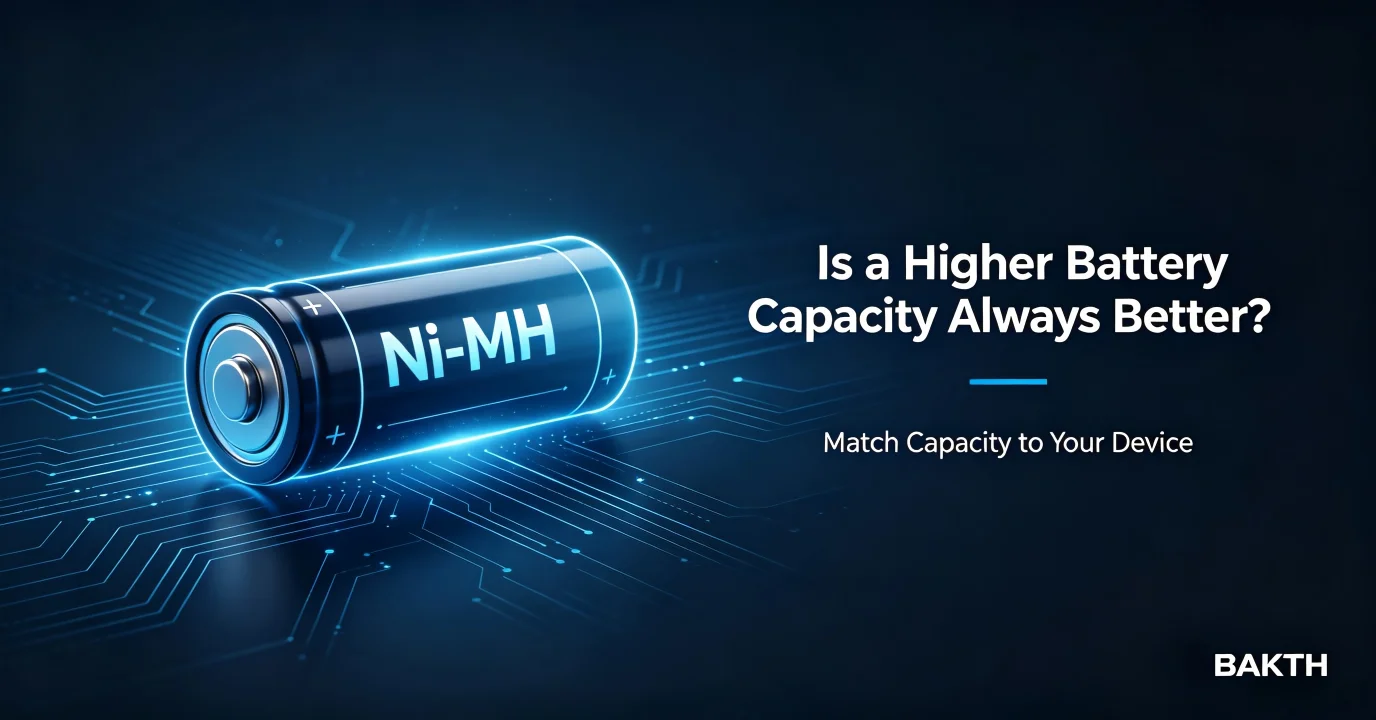
Most shoppers pick rechargeable batteries by mAh rating, assuming higher capacity equals a better product. While larger mAh numbers sound appealing, especially for Ni-MH rechargeables, this common belief overlooks critical trade-offs. High-capacity cells often sacrifice cycle life and long-term durability. This article explains when low-capacity Ni-MH batteries outperform their high-spec counterparts and how to select the right cell for your equipment.
Ni-MH cell manufacturers push capacity limits by packing more active materials inside the fixed casing of AA or AAA cells. This engineering tweak boosts mAh ratings, yet it creates a major downside: shorter service life and fewer charge cycles.
Within the same brand lineup, the difference can be dramatic. A standard 2000 mAh AA Ni-MH battery will typically last 2 to 4 times longer than a maximum-capacity 2500 mAh AA variant. Even more striking: low-capacity cells such as 1000 mAh AA deliver double the charge cycles compared to 2000 mAh options. Some low-rated AAA and AA Ni-MH batteries can remain operational for more than a decade, up to 10 times longer than top-tier high-capacity models.
Beyond superior longevity, many everyday electronics never fully leverage the rated capacity of premium high-mAh batteries. In low-drain hardware, swapping in a battery with half the capacity barely shortens usable runtime.
Remote controls, wall clocks and weighing scales draw minimal current and run months on a single set of rechargeables. For these gadgets, expensive high-capacity Ni-MH cells bring little benefit economically or environmentally. Lower-capacity Ni-MH rechargeables work perfectly as drop-in replacements for disposable batteries, plus Ni-MH chemistry avoids leakage issues common to primary dry cells.
This principle also applies to solar garden lights, animal repellers, DECT cordless phones and wireless headsets. These devices use intermittent, partial charging cycles. Oversized high-capacity cells rarely reach a full charge, accelerating premature degradation. The golden rule: match battery capacity to, or slightly exceed, the original factory cell installed in your device.
Low-capacity Ni-MH cells offer practical advantages many buyers overlook:
Pre-charged ready-to-use Ni-MH batteries like the everActive Infinity Line 550 mAh AAA cells are engineered specifically for low-current applications. Designed for solar lamps, cordless phones, remote controls and wall clocks, these cells deliver stable performance without the shortened lifespan found in ultra-high-capacity alternatives.
A: Not entirely. High-mAh Ni-MH works well for high-drain devices such as flashlights or portable radios that fully drain the battery on each use. They are a poor fit for low-power electronics.
A: Ni-MH rechargeable cells have far lower leakage risk compared to zinc primary batteries when stored and used correctly.
A: Hearing aids and cochlear implants require specialised size 675 implant-grade batteries. Brands including everActive Implant HD, Power One Implant Plus and Rayovac Implant Pro+ are built to sustain stable current without sharp voltage drops during use.
Higher mAh ratings do not automatically translate to a better rechargeable battery. High-capacity Ni-MH cells come with noticeable trade-offs, most significantly a steep reduction in cycle count and total service life.
For low-drain household electronics, low-capacity Ni-MH rechargeables provide comparable runtime, far longer durability and better value. Instead of chasing the largest mAh figure, match your battery selection to your device’s power draw and charging pattern to maximise battery lifespan and cut long-term costs.