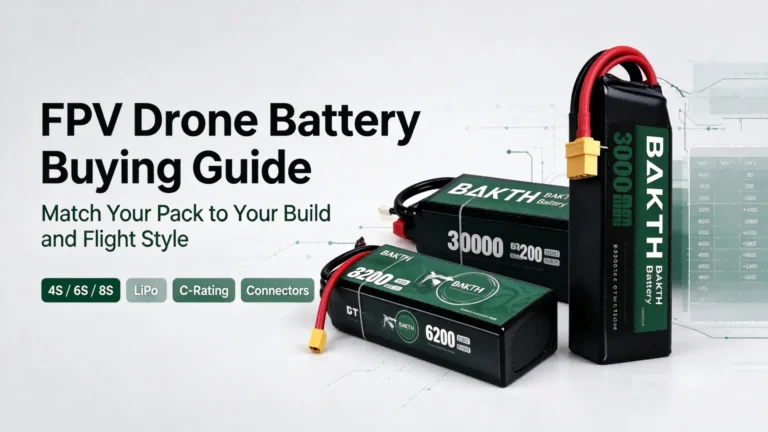




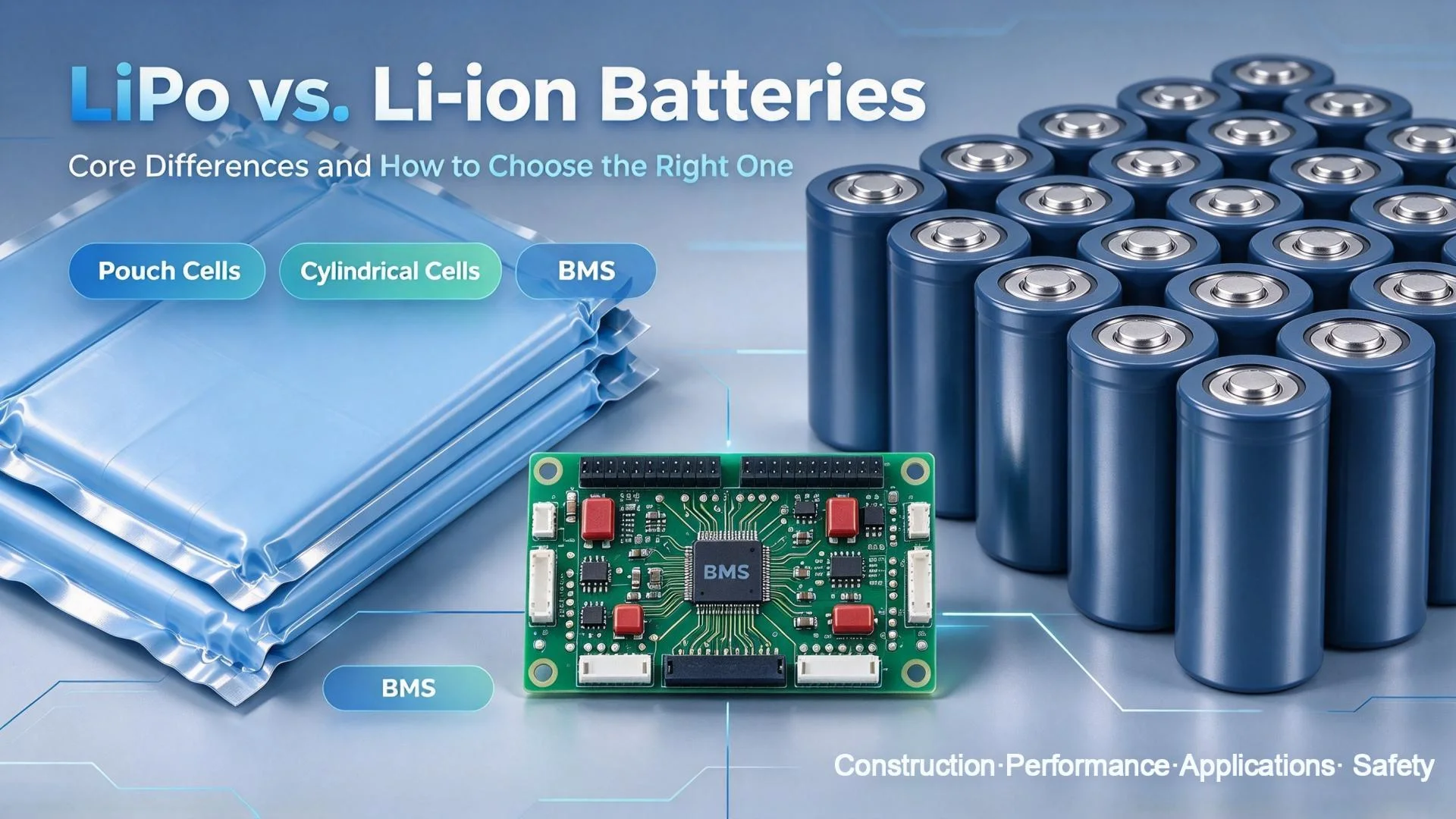
Choosing between lithium polymer (LiPo) and conventional lithium-ion (Li-ion) batteries is an important decision for OEMs, product designers, and system integrators. Although LiPo batteries belong to the broader lithium-ion battery family, differences in cell construction, packaging, and performance characteristics make certain designs better suited to specific applications.
This guide compares LiPo and conventional Li-ion batteries, explores their advantages and limitations, and explains how to select the right battery for your project.
1. What Is a LiPo Battery?
LiPo stands for lithium polymer battery. In commercial applications, the term commonly refers to lithium-ion cells packaged in flexible, laminated aluminum pouches. Their electrolyte formulations vary, so not all LiPo batteries use a gel-based or semi-solid electrolyte.
One of the main advantages of pouch cells is their design flexibility. Unlike rigid cylindrical cells, they can be manufactured in a range of thicknesses and dimensions, making them suitable for products with limited or irregular internal space.
Some LiPo cells are also designed to deliver high discharge currents, making them a good fit for applications that require short bursts of power.
Common applications include:
- Drones and unmanned aerial vehicles (UAVs)
- Radio-controlled (RC) vehicles
- Wearable electronics
- Slim handheld devices
- Compact portable equipment
However, pouch cells lack the rigid outer casing found in cylindrical cells. They therefore require appropriate mechanical support and protection against puncture, crushing, and excessive compression.
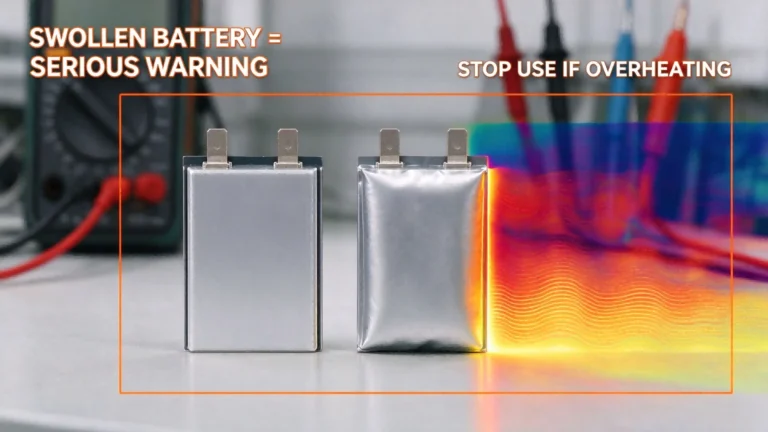
Under certain conditions, including aging, overcharging, excessive heat, or internal damage, gas can accumulate inside a pouch cell and cause swelling. A swollen battery should be taken out of service and handled according to appropriate battery safety procedures.
Cycle life varies by cell chemistry, design, discharge rate, depth of discharge, temperature, and charging conditions. Rather than assuming a universal lifespan of 300–800 cycles, buyers should request cycle-life data for the specific battery model under defined test conditions.
2. What Is a Conventional Li-ion Battery?
In comparisons with LiPo batteries, conventional Li-ion batteries generally refer to cylindrical or prismatic cells with rigid housings, such as the widely used 18650 and 21700 formats.
These cells typically use a liquid electrolyte to facilitate lithium-ion movement between the anode and cathode during charging and discharging. Their rigid housings provide structural support and help protect internal components during normal handling and operation.
Standardized cell formats and mature manufacturing processes also make many cylindrical and prismatic cells widely available, helping manufacturers control costs in large-volume production.
Different lithium-ion chemistries offer different combinations of energy density, power capability, thermal stability, and cycle life. Common options include nickel manganese cobalt oxide (NMC) and lithium iron phosphate (LiFePO4 or LFP).
LiFePO4 cells are widely used in applications where cycle life and thermal stability are important, including:
- Stationary energy storage systems
- Backup power equipment
- Automated guided vehicles (AGVs) and autonomous mobile robots (AMRs)
- Industrial equipment
- Electric mobility systems
- Selected medical and monitoring devices
Some LiFePO4 cells can achieve several thousand cycles under suitable operating conditions. However, actual cycle life depends on the cell specifications, operating temperature, depth of discharge, charging profile, and end-of-life criteria.
Rigid cell construction does not eliminate battery safety risks. Cell quality, electrical protection, thermal management, and pack design remain essential.
3. LiPo and Li-ion: What Do They Have in Common?
A common misconception is that LiPo and Li-ion batteries are two completely separate battery chemistries. In fact, LiPo batteries are generally a type of lithium-ion battery.
Both store and release energy through the movement of lithium ions between the anode and cathode. Both are rechargeable and require appropriate charging controls and protection measures.
Depending on the battery design, a battery management system (BMS) can monitor cell voltage, current, and temperature, provide cell balancing, and disconnect the battery when specified protection limits are reached.
Both types can also be damaged by overcharging, excessive discharge, high temperatures, physical abuse, or internal faults. Under severe failure conditions, either type can experience thermal runaway.
For buyers, the more useful comparison is between flexible pouch cells and rigid cylindrical or prismatic cells, while also considering the specific chemistry and performance ratings of each product.
4. LiPo vs. Li-ion: Key Differences
The following table compares common pouch-cell and rigid-cell designs. These are general tendencies rather than universal rules; actual performance depends on the individual cell model and chemistry.
| Feature | LiPo (Pouch Cells) | Conventional Li-ion (Cylindrical or Prismatic Cells) |
|---|---|---|
| Packaging | Flexible laminated pouch | Rigid cylindrical or prismatic housing |
| Design flexibility | Suitable for slim and customized shapes | More constrained by cell dimensions |
| Space utilization | Can fit compact or irregular spaces efficiently | Depends on cell format and pack arrangement |
| Discharge performance | Some models support very high discharge rates | Ranges from low-power to high-power designs |
| Cycle life | Depends on chemistry, design, and operating conditions | Depends on chemistry, design, and operating conditions |
| Mechanical protection | Requires suitable external support | Rigid housing provides additional structural protection |
| Cost | Depends on customization, volume, and specifications | Standardized cells can be cost-effective at scale |
| Key design considerations | Swelling allowance, pouch protection, and mechanical support | Cell arrangement, electrical connections, and thermal management |
Neither format is automatically superior in every category. A high-discharge pouch cell may outperform a standard cylindrical cell in power delivery, while a well-designed rigid-cell battery may provide a longer service life than a pouch cell intended for a different application.
For a meaningful comparison, evaluate specific cell models under equivalent operating conditions.
5. When Should You Choose LiPo Batteries?
LiPo pouch cells are worth considering when a product requires low weight, compact dimensions, flexible packaging, or high discharge capability.
They are particularly useful when standard cylindrical or prismatic cells cannot efficiently fit the available enclosure.
Typical LiPo Applications
Drones and RC equipment
Some drones and RC products require high power output relative to battery weight. High-discharge pouch cells can be suitable when their current ratings, weight, and thermal limits meet the design requirements.
Slim and compact electronics
Wearables, handheld devices, and other space-constrained products can benefit from pouch cells because their dimensions can be customized to fit the enclosure.
Custom-shaped battery packs
When installation space is unusually thin or irregular, pouch cells can provide greater flexibility during battery pack design.
What Should Buyers Consider?
Pouch cells require appropriate mechanical support and protection against puncture, crushing, and excessive compression. The enclosure must also account for swelling and expansion according to the cell manufacturer’s specifications.
Before sourcing a LiPo battery pack, confirm:
- Continuous and peak discharge current
- Rated capacity and operating voltage
- Charging current and temperature limits
- Required cycle life under the intended duty cycle
- Mechanical protection and enclosure design
- BMS protection and monitoring requirements
LiPo batteries are not inherently unsuitable for long-cycle industrial applications. Their suitability depends on the specific cell’s performance, construction, environmental requirements, and expected service life.
6. When Should You Choose Conventional Li-ion Batteries?
Cylindrical and prismatic Li-ion cells are often a strong choice when a project prioritizes standardized formats, structural protection, broad availability, or cost-effective production at scale.
The most suitable chemistry and cell model depend on the application’s energy, power, and lifetime requirements.
Typical Applications
Energy storage and backup power
LiFePO4 cells are commonly used in stationary energy storage and backup systems because of their thermal stability and potential for long cycle life under suitable operating conditions.
AGVs, AMRs, and industrial equipment
Material handling systems and mobile industrial equipment may benefit from rigid cell housings and established cell formats. Vibration resistance, operating temperature, peak current, and charging frequency should also be considered.
Electric mobility
E-bikes, scooters, and other electric mobility products can use cylindrical, prismatic, or pouch cells. The choice depends on energy density, power output, weight, enclosure requirements, and cost.
Medical and industrial monitoring equipment
Portable medical and industrial monitoring devices may use different cell formats depending on available space, power demand, reliability requirements, and applicable regulatory standards.
What Should Buyers Consider?
When selecting a conventional Li-ion battery pack, check:
- Cell chemistry and manufacturer specifications
- Continuous and peak discharge ratings
- Required capacity and operating voltage
- Pack dimensions, weight, and mechanical requirements
- Thermal management and BMS configuration
- Cycle-life data under the intended operating conditions
- Availability, traceability, and quality-control documentation
Rigid cells are not automatically longer-lasting or safer than pouch cells. These characteristics must be verified using cell specifications and pack-level testing.
7. Safety Best Practices for Both Battery Types
Both LiPo and conventional Li-ion batteries require appropriate protection and handling. Safety depends on the complete battery system, not just the cell packaging.
Follow these best practices when designing, sourcing, or operating a lithium battery pack:
- Use a suitable BMS. Select protection functions according to the cell chemistry, series configuration, current requirements, and system design. Relevant functions may include overvoltage, undervoltage, overcurrent, short-circuit, and overtemperature protection.
- Use a compatible charger. Charging voltage, current limits, charging profile, and temperature restrictions must match the battery manufacturer’s specifications.
- Protect against physical damage. Prevent puncture, crushing, excessive vibration, and damage to wires or terminals. Pouch cells require particular attention to enclosure support and protection.
- Monitor operating temperature. Avoid charging or discharging outside the specified temperature range. Provide appropriate ventilation or thermal management where required.
- Watch for warning signs. Stop using a battery if it becomes abnormally hot, swells, leaks, emits an unusual odor, or shows signs of physical damage. Do not charge or reuse a damaged or swollen battery.
- Verify transportation and market requirements. Lithium battery shipments are subject to applicable transport regulations, including UN 38.3 testing requirements where relevant. Additional product certifications or regional compliance requirements depend on the product and target market.
For OEMs and industrial buyers, safety validation should cover the complete battery pack, including cells, BMS, wiring, connectors, enclosure, charging system, and intended operating environment.
8. How to Select the Right Battery for Your Project
Before choosing between LiPo and conventional Li-ion cells, define your product requirements and compare actual battery specifications.
- Define Space and Weight Constraints
If the enclosure is slim or irregularly shaped, pouch cells may provide greater design flexibility. If the product can accommodate standard cell dimensions, cylindrical or prismatic cells may be more practical. - Calculate Energy and Power Requirements
Determine the required voltage, capacity, continuous discharge current, peak current, and expected operating duration. Do not select a battery based on capacity alone; the cells must also support the application’s power demand. - Set Your Service-Life Target
Estimate daily charge and discharge cycles, depth of discharge, operating temperature, and expected service life. Ask suppliers for cycle-life data under conditions that resemble your actual application. - Evaluate Safety and Environmental Conditions
Consider vibration, shock, humidity, dust, water exposure, ambient temperature, and available cooling. The enclosure and protection system should be designed for the environment in which the battery will operate. - Compare Total Cost, Not Just Cell Price
The overall cost includes more than the cells themselves. BMS design, mechanical protection, thermal management, assembly, testing, certification, warranty exposure, and maintenance can all affect the total cost of ownership. For B2B projects, request technical specifications and validate samples before committing to mass production. This helps ensure that the selected battery technology meets the requirements of the finished product.
9. Final Thoughts
There is no universally better choice between LiPo and conventional Li-ion batteries. The right solution depends on the specific cell design, chemistry, performance requirements, and application environment.
LiPo pouch cells can be an excellent fit for lightweight products, slim enclosures, customized shapes, and applications requiring high discharge capability. Cylindrical and prismatic Li-ion cells offer established form factors, rigid housings, and a wide range of chemistry and performance options.
For OEMs, equipment manufacturers, and procurement teams, the best approach is to evaluate the complete battery solution rather than relying on the LiPo or Li-ion label alone.
The right battery is the one that meets your requirements for power, energy, dimensions, service life, safety, and total cost of ownership.
10. Frequently Asked Questions
A: Neither type is inherently safer in every situation. Pouch cells require appropriate mechanical protection and swelling management, while rigid cells provide additional structural support. Safety depends on cell quality, chemistry, BMS design, pack construction, charging controls, and operating conditions.
A: Not without checking the system requirements and potentially redesigning the battery pack. Differences in dimensions, voltage configuration, discharge capability, connectors, thermal behavior, and BMS settings can affect compatibility and safety.
A: Standard cylindrical cells can be cost-effective because of their established manufacturing processes and broad availability. However, the final cost depends on cell specifications, production volume, pack design, assembly requirements, and testing. A customized pouch-cell pack may be more economical when it fits the product design more efficiently.
A: The required functions depend on the cell specifications and pack configuration. They may include cell overvoltage and undervoltage protection, overcurrent and short-circuit protection, temperature monitoring, and cell balancing where applicable. Protection thresholds must follow the cell manufacturer’s requirements.
A: Neither format guarantees a longer cycle life. Service life depends on chemistry, cell design, charging and discharging conditions, operating temperature, and the required end-of-life capacity. Compare test data for specific cells under equivalent conditions.
A: Yes, when the selected cells meet the application’s power, energy, mechanical, environmental, and service-life requirements. Pouch cells can be suitable for compact industrial equipment and specialized devices, provided the pack includes appropriate structural protection and safety controls.