



Battery performance declines over months and years of real-world use. To predict how a cell will behave long before it reaches end customers, manufacturers run a structured series of aging tests. These tests measure capacity fade, internal resistance growth, thermal stability, and safety margins. This guide walks through the most common battery aging test items, what each one reveals, and why procurement teams should review the data before ordering custom packs.
1. What Is Battery Aging?
Battery aging is the gradual deterioration of cell performance caused by repeated cycling, internal chemical side reactions, temperature exposure, calendar time in storage, and mechanical stress. Over time, aging reduces usable capacity, raises internal resistance, lowers peak power output, and can compromise safety.
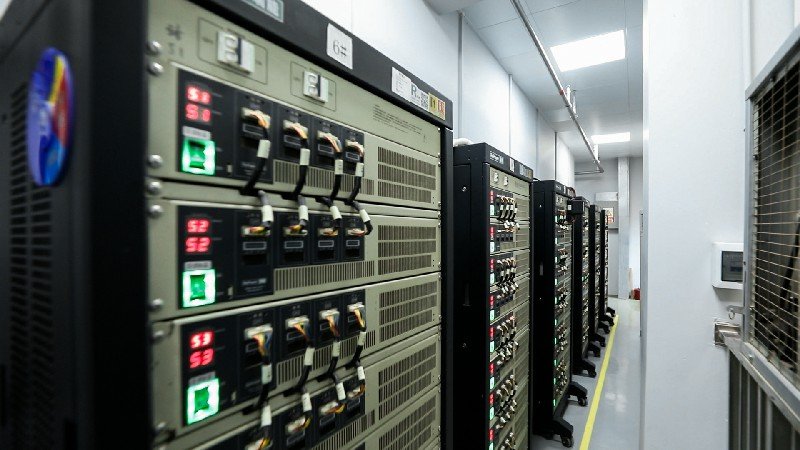
Aging tests are designed to simulate years of real-world operation in a compressed laboratory timeframe. The goal is to predict service life, identify weak designs, and verify that a battery remains safe long after its first charge.
1.1 Capacity Retention Test
The capacity retention test measures how much energy a battery can still hold after a defined number of charge-discharge cycles.
Standard test parameters typically use 0.5C charge and 0.5C discharge at 25°C. Engineers record capacity at set milestones — often 300, 500, and 1,000 cycles. Capacity retention is calculated as a percentage of the original fresh-cell capacity.
This is the single most widely used indicator of battery health. A pack that retains 80% capacity after 1,000 cycles tells engineers the cell chemistry and BMS are performing as designed.
1.2 Cycle Life Test
Cycle life testing pushes a battery until it reaches its defined end-of-life threshold. Most manufacturers set end-of-life at 80% of original capacity; some heavy-duty industrial applications use 70%.
Cycle life is critical for energy storage systems, electric vehicles, medical equipment, and any product where battery replacement costs or downtime are high. A short cycle life means warranty claims and customer returns.
1.3 Internal Resistance Growth Test
As cells age, internal resistance rises. Higher resistance generates more heat under load, increases voltage sag, and reduces peak power delivery.
Engineers measure resistance using AC impedance or DC pulsedischarge methods. A typical fresh lithium cell might sit at 20 mΩ; after 1,000 cycles it could climb to 40 mΩ or more. Tracking resistance growth over time is often a more sensitive early-warning signal than capacity alone.
1.4 High-Temperature Storage Test
Elevated temperature accelerates chemical aging dramatically. In high-temperature storage tests, cells are held at 45°C, 60°C, or even 70°C for periods of 7, 30, or 90 days.
Engineers evaluate capacity loss, voltage change, swelling, leakage, and resistance increase after storage. This test exposes reliability problems that might not appear under mild room-temperature conditions.
1.5 Low-Temperature Performance Test
Cold weather reduces lithium ion mobility and lowers discharge capacity. Low-temperature testing runs cells at 0°C, -10°C, -20°C, or -40°C, measuring discharge capacity, voltage stability, and power output.
This matters for outdoor equipment, automotive systems, and medical devices that must operate reliably in winter climates.
1.6 Calendar Aging Test
Not all aging comes from cycling. Calendar aging measures degradation during storage at different temperatures and states of charge.
Common test matrices store cells at 25°C and 45°C, each at 50% and 100% state of charge, for months at a time. Engineers track capacity loss, self-discharge rate, and resistance increase. Calendar aging is essential for backup batteries and emergency devices that spend most of their life idle.
1.7 Self-Discharge Test
Self-discharge measures how much energy a battery loses while sitting unused. After a full charge, cells are stored for 7, 30, 90 days or longer, then re-measured.
Low self-discharge is critical for emergency power supplies, smoke detectors, and standby systems where batteries must remain ready after months of storage.
1.8 Rate Capability Aging Test
Some batteries hold total capacity but lose the ability to deliver high current as they age. Rate capability testing discharges aged cells at 0.2C, 0.5C, 1C, 2C, and 5C to measure how high-rate performance degrades.
This is especially important for power tools, drones, and jump starters that depend on peak current bursts.
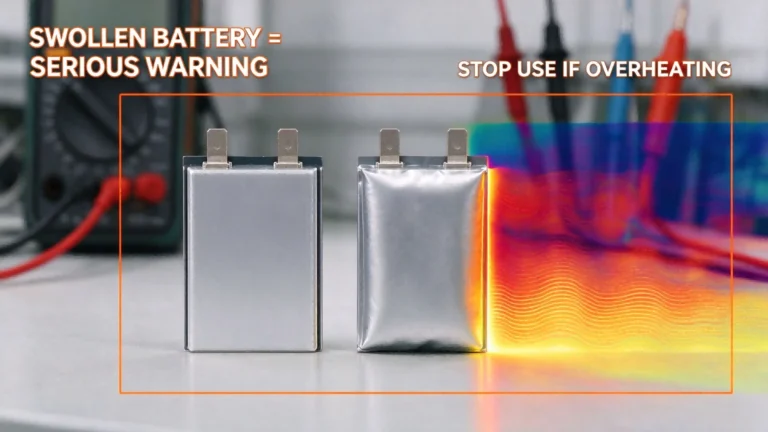
1.9 Swelling and Thickness Test
Lithium polymer and high-energy-density cells physically expand as gas builds up inside. Swelling tests measure thickness increase, weight change, and visual deformation over cycling.
Excessive swelling signals internal gas generation and potential safety risks. For pouch-cell packs, controlled swelling accommodation is part of the mechanical design.
1.10 Safety Aging Tests
A battery that is safe when new must remain safe after years of use. Safety aging tests are performed on already-cycled cells and include overcharge, short-circuit, crush, nail penetration, and thermal abuse tests.
Passing these tests on aged cells confirms that degradation does not create hidden thermal runaway risks.
2. Common Aging Test Standards
Manufacturers reference internationally recognized test standards:
- IEC 61960: Performance requirements for lithium batteries
- IEC 62133: Safety requirements for portable sealed rechargeable cells
- UL 1642 / UL 2054: Safety and reliability certification
- UN 38.3: Transportation safety testing
- ISO 12405 / SAE J2929: Automotive and electric vehicle battery standards
3. Why Aging Test Data Matters for Buyers
When sourcing custom lithium battery packs, aging test reports tell you:
- Real expected cycle life under your operating conditions
- How much capacity fades after 6, 12, or 24 months
- Whether the pack holds up in your climate range
- That safety certifications remain valid over the product lifecycle
Always request aging test data from suppliers. A manufacturer that cannot provide cycle life, resistance growth, and high-temperature storage results is cutting corners.
4. Frequently Asked Questions
A: Standard cycle life testing runs 500–1,000 cycles and can take several weeks. Calendar aging studies may run 6–12 months or longer.
A: Cycle aging comes from repeated charge-discharge use. Calendar aging happens simply from time passing, even when the battery sits unused.
A: Most manufacturers define end-of-life at 80% of original capacity. Some industrial applications use 70%.
A: Not exactly. Real-world conditions vary, but rigorous aging tests provide a reliable estimate and expose design weaknesses before mass production.
A: No. LiFePO4 typically shows slower capacity fade and longer cycle life than NMC cells. LFP cells also age differently under high-temperature storage.
5. Final Takeaway
Battery aging testing is the bridge between lab performance and real-world reliability. A comprehensive test program covers capacity retention, cycle life, internal resistance, temperature extremes, self-discharge, swelling, and safety verification. For battery buyers, demanding aging test data is one of the most effective ways to avoid warranty claims, safety incidents, and premature pack failure.